Frost monitoring records the thermal conditions affecting crops and the operation of protection equipment. Air temperature, tissue or canopy temperature, humidity and wind describe different parts of the event. An effective observation network represents vulnerable locations and retains the timing needed to interpret cooling and protection responses.
Radiation and advection frost
Radiation frost commonly develops under clear skies and light winds when the surface loses more radiant energy than it receives. The surface and nearby air cool, and temperature can increase with height, forming an inversion. Cold air can accumulate in low terrain, making a single elevated station unrepresentative of the coldest crop exposure.
Advection frost involves the arrival of cold air and is often accompanied by stronger wind and a less favourable inversion for mixing-based protection. Actual events may contain both processes. Wind machines, heaters and sprinklers interact with these conditions differently; temperature readings must be interpreted alongside the weather pattern and the protection method.
Plant injury depends on species, cultivar, tissue development, temperature and exposure duration. A universal 0°C alarm cannot represent every crop's damage threshold. Visible frost is also not a complete indicator of injury: tissues can freeze during dry conditions without conspicuous ice deposition.
Instruments for frost observation
The options below fulfil complementary roles. SKY WS supplies connected local weather through Pulse. Shielded temperature/humidity probes and thermistor probes support distributed air measurements, while an infrared radiometer measures the thermal emission of a viewed surface. A local logger serves site characterisation differently from a remotely connected operational station.
SKY WS LoRa station
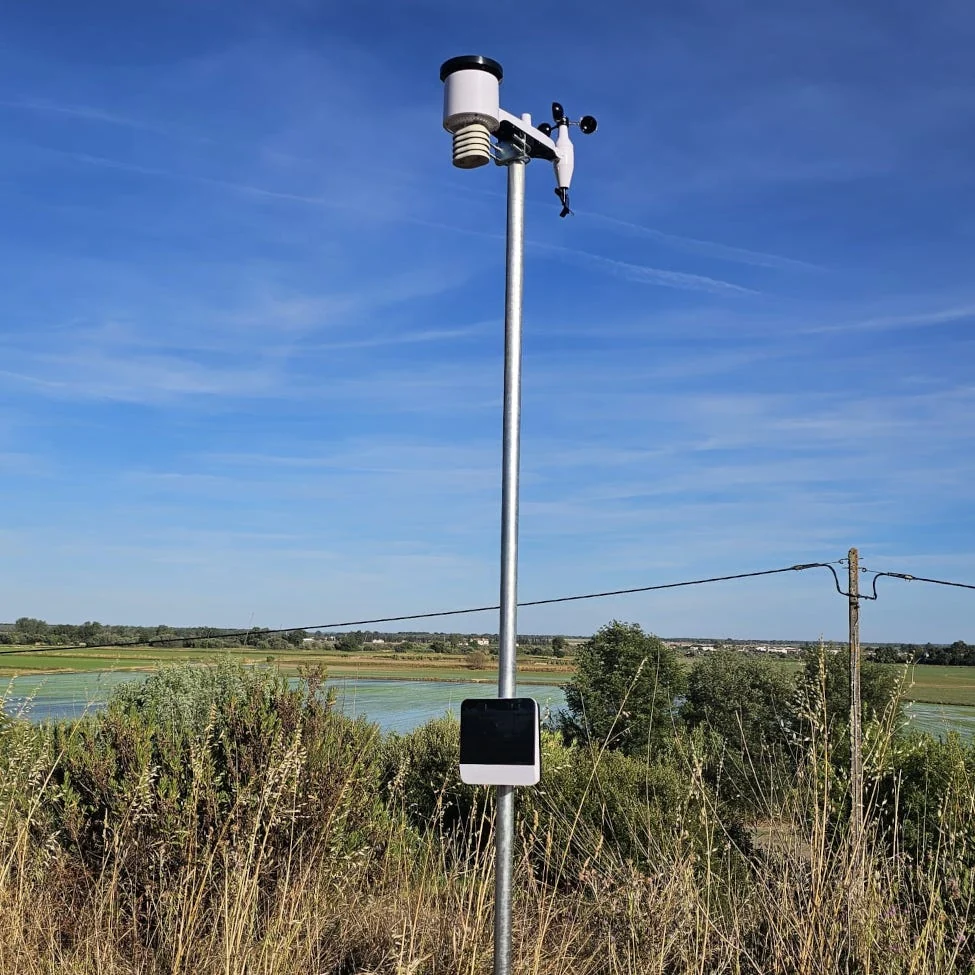
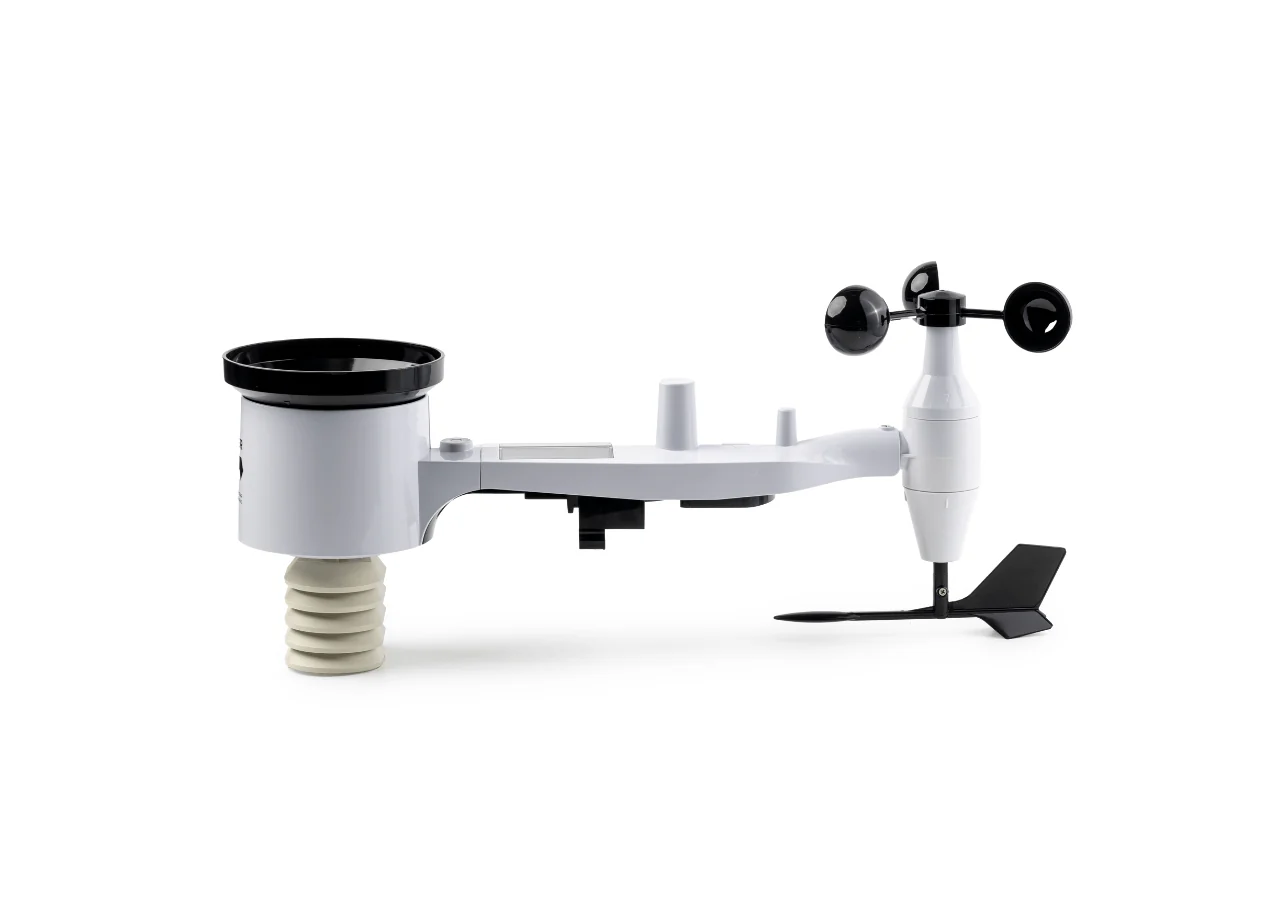
Pycno SKY WS
A compact six-variable station that fits naturally into a Pulse-based farm network. Solar radiation is included in the listed instrument set alongside rainfall, wind, temperature and humidity.
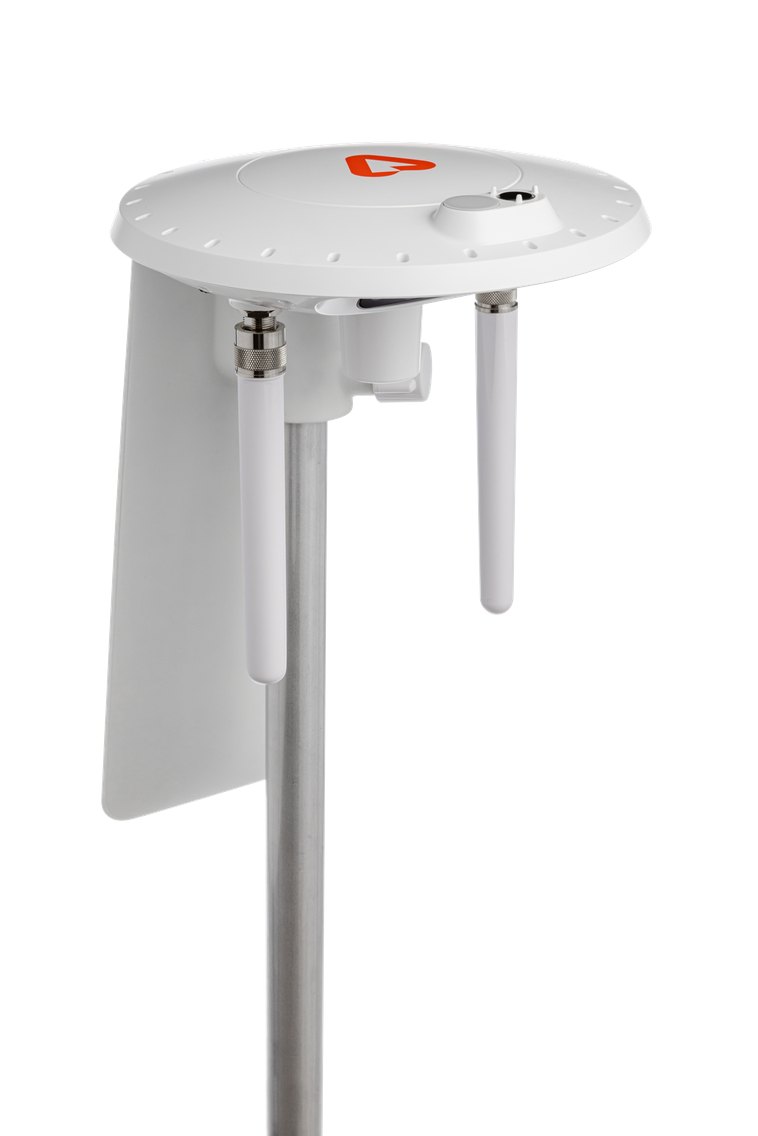
Use the matching regional LoRa frequency and include the gateway in the package.
View product details ↗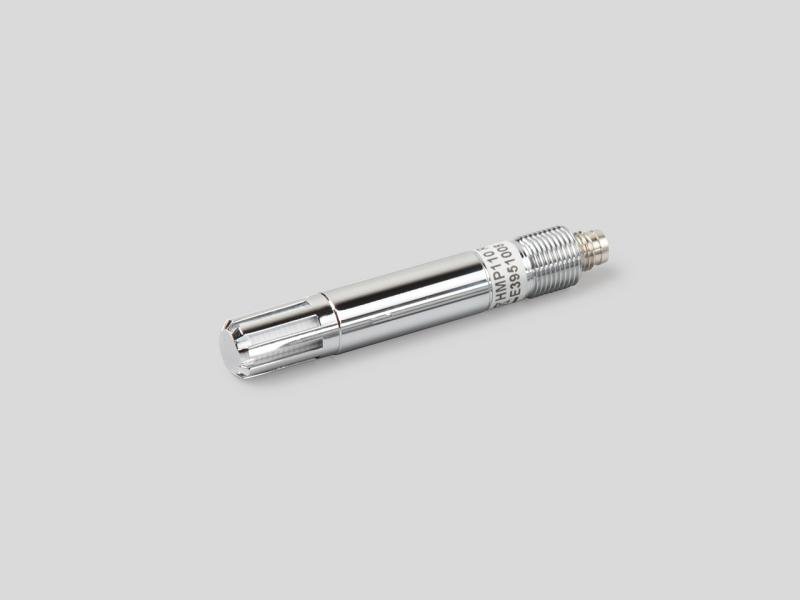
HMP110 humidity and temperature model; output selected at order
Vaisala HMP110
A compact industrial humidity and temperature probe with a detachable M8 cable. Analog and digital output configurations support different host instruments.
HMP110T is temperature-only; a bare probe needs suitable siting and shielding.
View product details ↗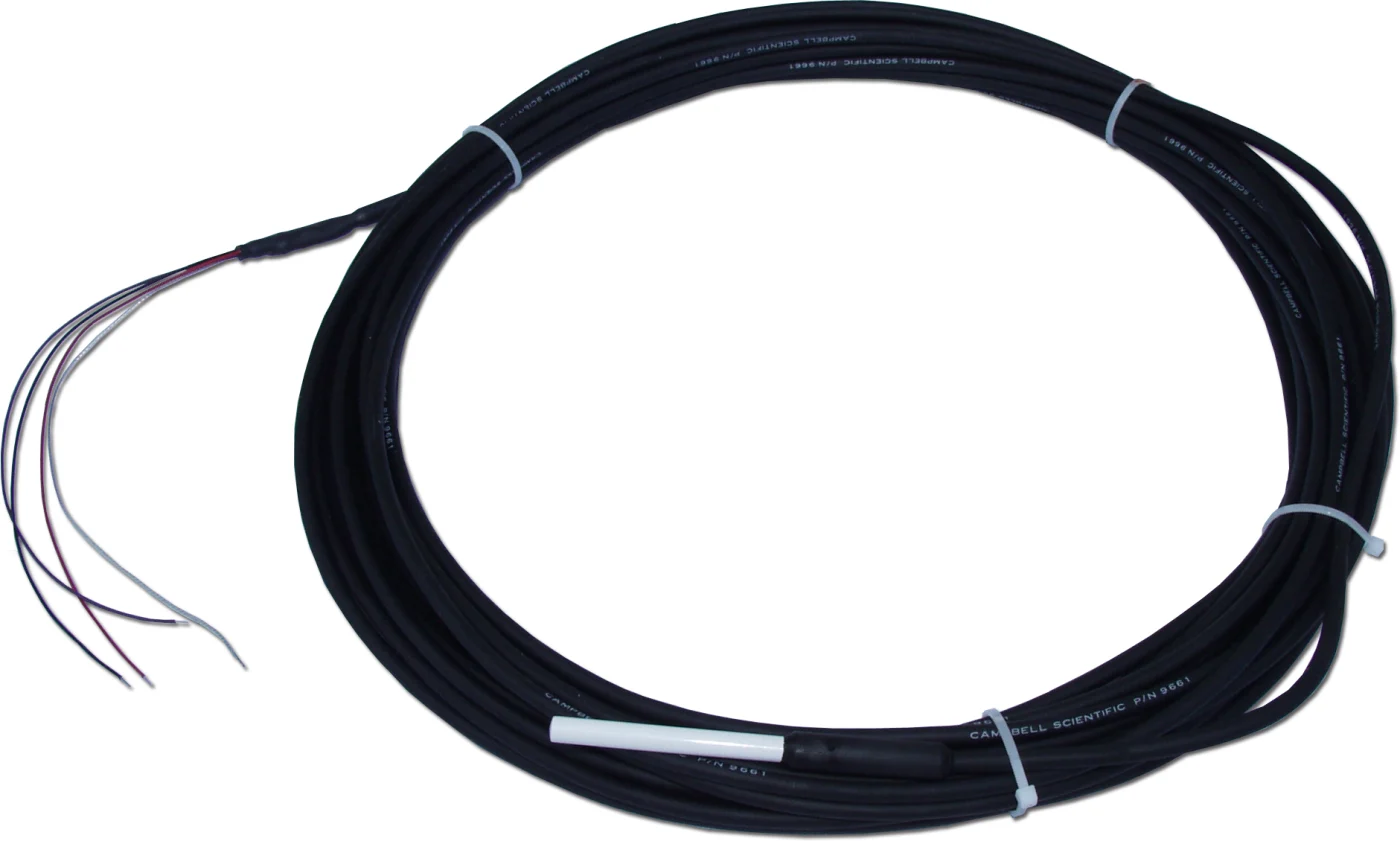
109 analogue thermistor probe
Campbell Scientific 109
An encapsulated thermistor probe for environmental temperature measurements. Its compact sensor can support multiple monitoring heights when connected to suitable data acquisition equipment.
Air measurements require a radiation shield; power, logger and telemetry are separate.
View product details ↗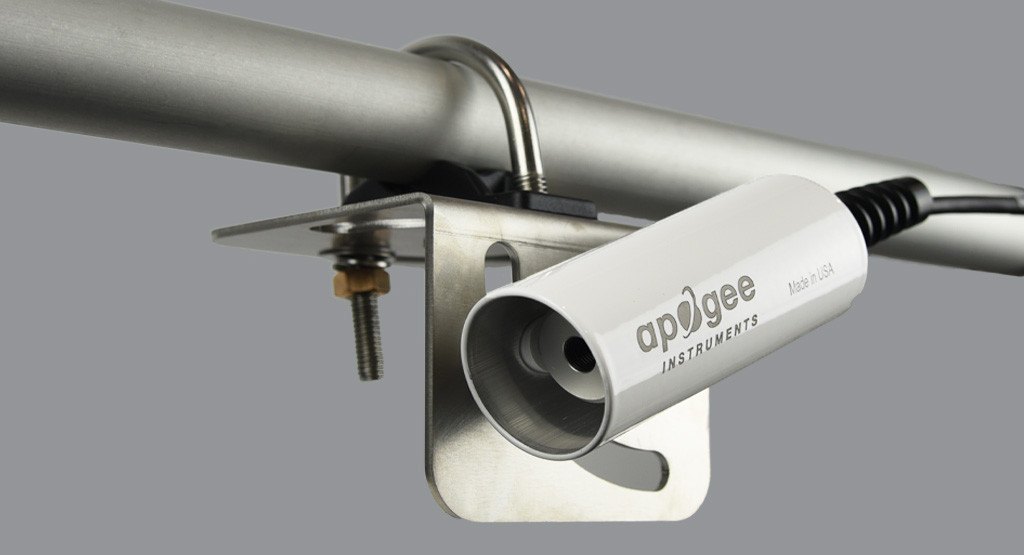
SI-111-SS analogue variant
Apogee SI-111-SS
A dedicated radiometer used for canopy temperature and surface energy-balance observations. The specified 22° half-angle defines a footprint that must remain predominantly vegetation.
Requires appropriate analogue measurement, canopy coverage and stable mounting.
View product details ↗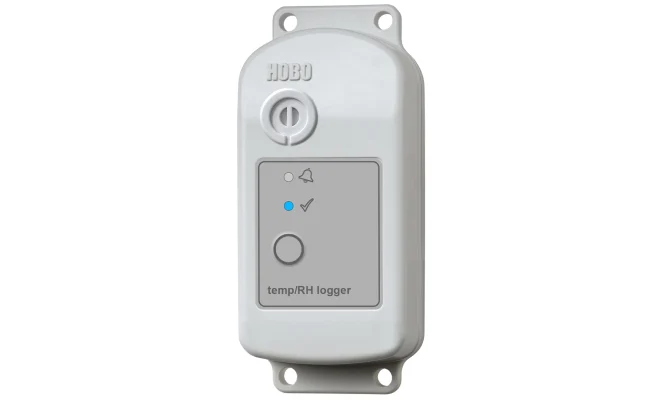
Internal temperature/RH Bluetooth logger
Onset HOBO MX2301A
A weatherproof battery logger for local temperature and humidity records. Bluetooth supports nearby setup and retrieval; a radiation shield is needed for representative exposed-air observations.
Shielded temperature response can be slow; remote alarms require additional communications.
View product details ↗| Model | Measurement / role | Data connection | Coverage / installation |
|---|---|---|---|
| Pycno SKY WS | Temperature, humidity, solar radiation, rainfall, wind speed and direction | Pulse LoRa Gateway required; not Terra Masters | Local weather at one station site |
| Vaisala HMP110 | Relative humidity and air temperature | Voltage outputs or optional RS-485; configured variant matters | Compact probe integrated into a shielded measurement installation |
| Campbell Scientific 109 | Temperature, −50 to 70°C | Excitation and analogue measurement through a compatible logger | One air, shallow-soil or water position |
| Apogee SI-111-SS | Surface temperature from thermal infrared, 8–14 µm | Unamplified analogue outputs to suitable logger | 22° half-angle field of view |
| Onset HOBO MX2301A | Air temperature and relative humidity | Bluetooth to HOBOconnect; supported gateway/service separately | One local air exposure |
Air, canopy and tissue temperature
Shielded air temperature is a reproducible atmospheric measurement when the exposure is documented. It is not necessarily the temperature of a flower or leaf losing heat to a clear sky. Place crop-height measurements near the vulnerable tissues and consider additional observations in depressions, sheltered areas and other known cold locations.
Infrared radiometers estimate surface temperature from thermal radiation. Their field of view must contain the intended canopy or tissue surface. Bare soil, supports and gaps between plants contribute to the reading when they occupy part of the viewed area. Emissivity, viewing geometry and sensor-body compensation remain part of the measurement.
A temperature difference between two heights can describe the local inversion. If a lower probe reads −2°C and an upper probe +1°C, the observed difference is 3°C at those specific locations and heights. This does not establish the inversion depth or the temperature of the entire crop. Both probes need comparable shielding and calibration for the difference to be interpretable.
Humidity and wet-bulb temperature
Dew point describes the temperature at which air becomes saturated with respect to liquid water under the stated conditions. Wet-bulb temperature describes cooling through evaporation from a wetted, ventilated surface. It can be below dry-bulb air temperature, particularly when the air is dry.
Wet-bulb conditions are important when assessing sprinkler protection because evaporation can cool a wetted surface while freezing water releases latent heat. Adequate application, coverage and continuity determine whether the balance protects the crop. Start and stop criteria must follow a crop- and system-specific protection procedure; one remote air-temperature threshold is insufficient to prescribe operation.
A calculated wet-bulb value depends on the temperature, humidity and atmospheric-pressure assumptions used. A physical wetted thermometer additionally depends on ventilation and wick condition. Preserve the method with the observation so measured and calculated values are not mixed unknowingly.
Records, communications and protection feedback
Separate the measurement interval, stored interval and communication delay. A short sampling interval does not make a remote alert timely if uploads are infrequent or coverage is lost. Instrument response also matters: the MX2301A manufacturer's shielded-air response is much slower than its minimum configurable logging interval.
SKY WS with Pulse suits installations that need local weather within a broader monitoring architecture. Distributed crop-height probes can then address exposures that the main station does not represent, subject to supported modules and sensor configurations. Hardware compatibility, alert services and communication availability should be specified for the actual installation.
Protection feedback can include wind-machine operating state, sprinkler pressure, flow and reservoir level. These observations establish whether equipment is operating as intended; a pump command alone does not prove adequate water delivery. Local control and independent protection measures need a defined response to missing or stale observations.
Review threshold crossings against local records after an event. Record crop stage, observed damage, equipment operation and sensor position. The resulting history helps refine the monitoring layout and operating criteria without treating one season's outcome as a universal threshold.
Development and terminology
Minimum thermometers and orchard observations preceded automatic frost networks. Electronic logging added temperature histories and remote access, while multiple-height measurements supported interpretation of inversions. FAO's 2005 frost-protection reference describes the energy balance and the differing conditions under which protection methods operate.
- Temperature inversion
- A layer in which air temperature increases with height.
- Radiation frost
- A frost event associated with surface radiative cooling, commonly under clear and relatively calm conditions.
- Wet-bulb temperature
- The temperature associated with evaporative cooling of a wetted, ventilated thermometer.
- Hysteresis
- A difference between activation and deactivation thresholds that limits repeated switching near a boundary.
Questions about frost monitoring
Can a standard weather station identify the coldest part of an orchard?
It records its own exposure. Additional crop-height observations are needed to characterise low areas and other distinct microclimates.
Does canopy temperature equal air temperature?
No. Radiative exchange, evaporation and exposure can create a difference. Interpret each measurement as the quantity its instrument observes.
Is a Bluetooth logger a remote frost alarm system?
A local logger stores records and supports nearby retrieval. Remote notification requires a supported communications and service arrangement with suitable availability and delay.