Instrument architecture
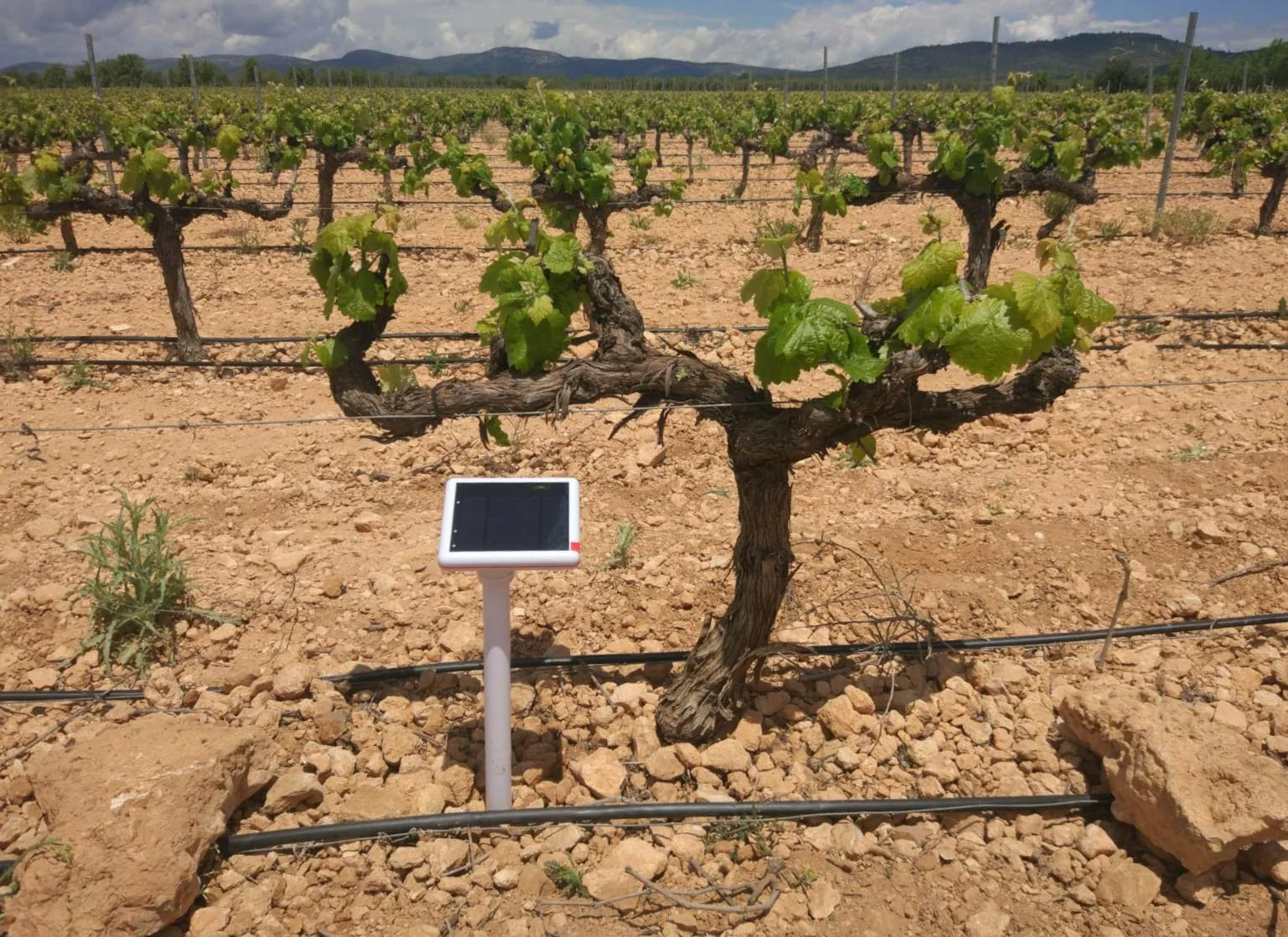
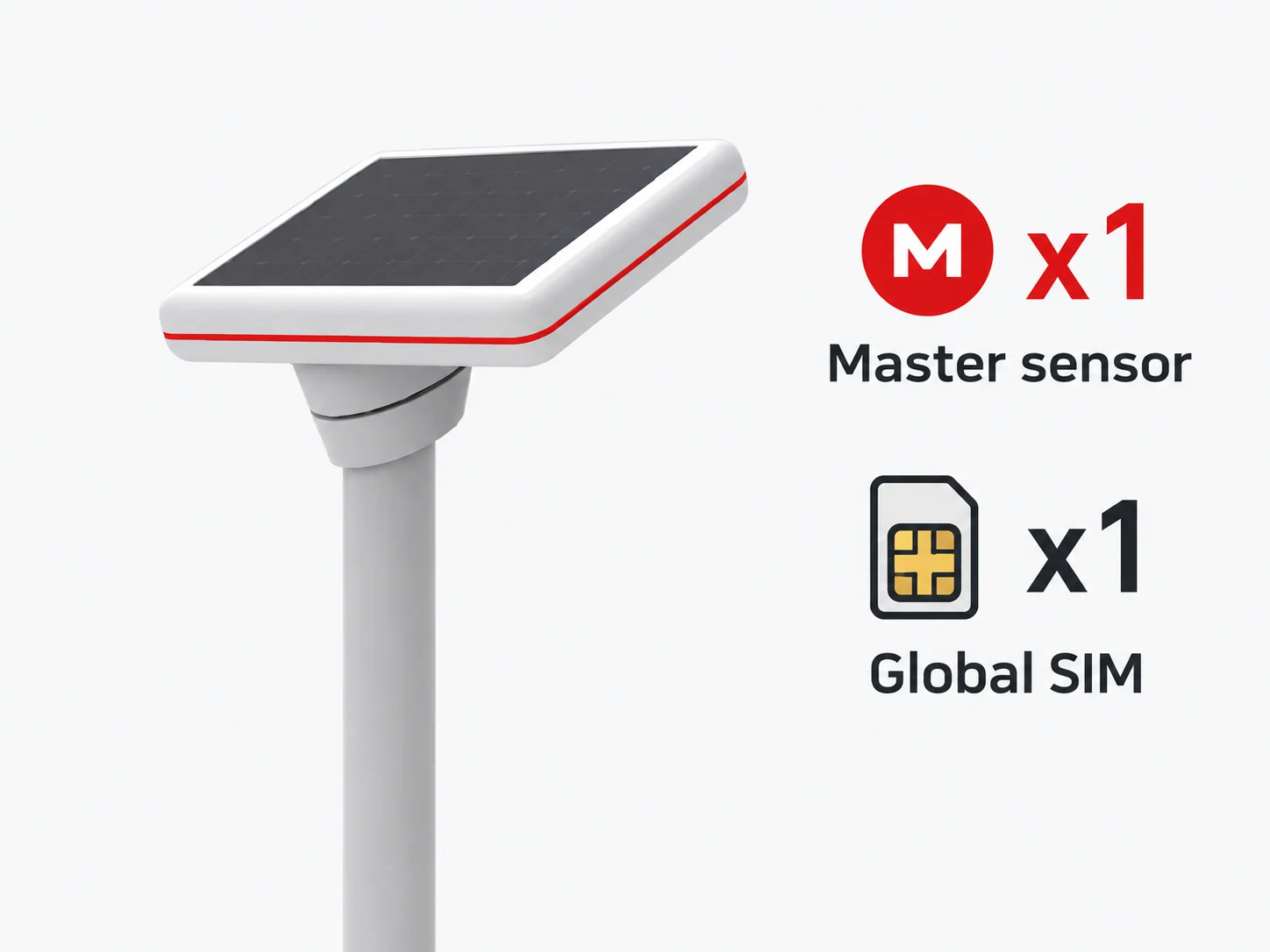
Pycno Terra combines a multi-depth soil probe with telemetry and solar-supported power. It is intended for continuous monitoring of the root zone, with measurements presented through the Pycno software platform. The configuration separates Master units, which provide cellular upload, from Nodes that communicate through a compatible Master.
This architecture is useful where a farm needs several measurement locations without equipping every position with a cellular connection. It also makes the location of the Master, local radio coverage and cellular service part of the installation design. The published local coverage description is not a guarantee of reception through every crop canopy or terrain profile.
Measured quantities and probe lengths
The product documentation lists soil moisture, soil temperature, air temperature, relative humidity and solar radiation. Moisture modules occur at 15 cm intervals, with 30, 60 and 90 cm probe-length options. Length should correspond to the crop's active root zone and the purpose of deeper monitoring. A longer instrument is useful when the additional depths answer a defined irrigation or drainage question.
The soil-moisture measurement uses capacitance. Changes in dielectric properties are converted into water-content estimates through calibration. The manufacturer describes water-content accuracy as soil dependent. Its stated digital resolution is not equivalent to field accuracy, which also depends on soil contact, texture, salinity and installation disturbance.
The ambient measurements provide context around the soil time series. A soil-monitoring installation does not automatically reproduce the exposure of a dedicated meteorological station, and radiation measurements should be interpreted with the instrument's documented spectral response and mounting arrangement.
Master and Node configuration
The Master product offers modem selection and regional LoRa-frequency options. The available 2G and 4G choices should be assessed against local network service and the intended operating lifetime. Nodes require the corresponding shared infrastructure; they should not be described as independent cellular instruments.
The product listing describes a Master as a hub for Nodes within a nominal 500 m radius. Terrain, antenna exposure, vegetation and interference affect that distance. A field survey and reception check at the planned locations are more informative than assuming a circular coverage area from the catalogue value.
A 2 W monocrystalline solar panel supports the internal battery. Panel shading and seasonal sunlight influence energy availability. The published battery description does not provide an unconditional operating duration for every sampling and communication configuration.
Software and interpretation
The Pycno platform documents visual sensor-data analysis, maps and heatmaps, rule-based alerts and spreadsheet export. Growing degree days and chilling hours provide agricultural context, while crop and irrigation areas can be represented on maps. The interface is particularly relevant to installations using Terra as the main field measurement network.
Alerts require thresholds and rules appropriate to the crop, soil and measurement depth. Exported data allow an agronomist to examine irrigation events, drying cycles and unusual readings alongside field observations. The platform's availability, account configuration and service arrangements form part of the complete system and should be confirmed for the proposed deployment.
Related soil-monitoring instruments
Terra offers a convenient integrated route into profile monitoring. Soil Mini extends the options for shallow wired positions. TEROS 12 and Drill & Drop provide established alternatives for projects with different measurement or acquisition requirements.
Terra Master; Node version also offered
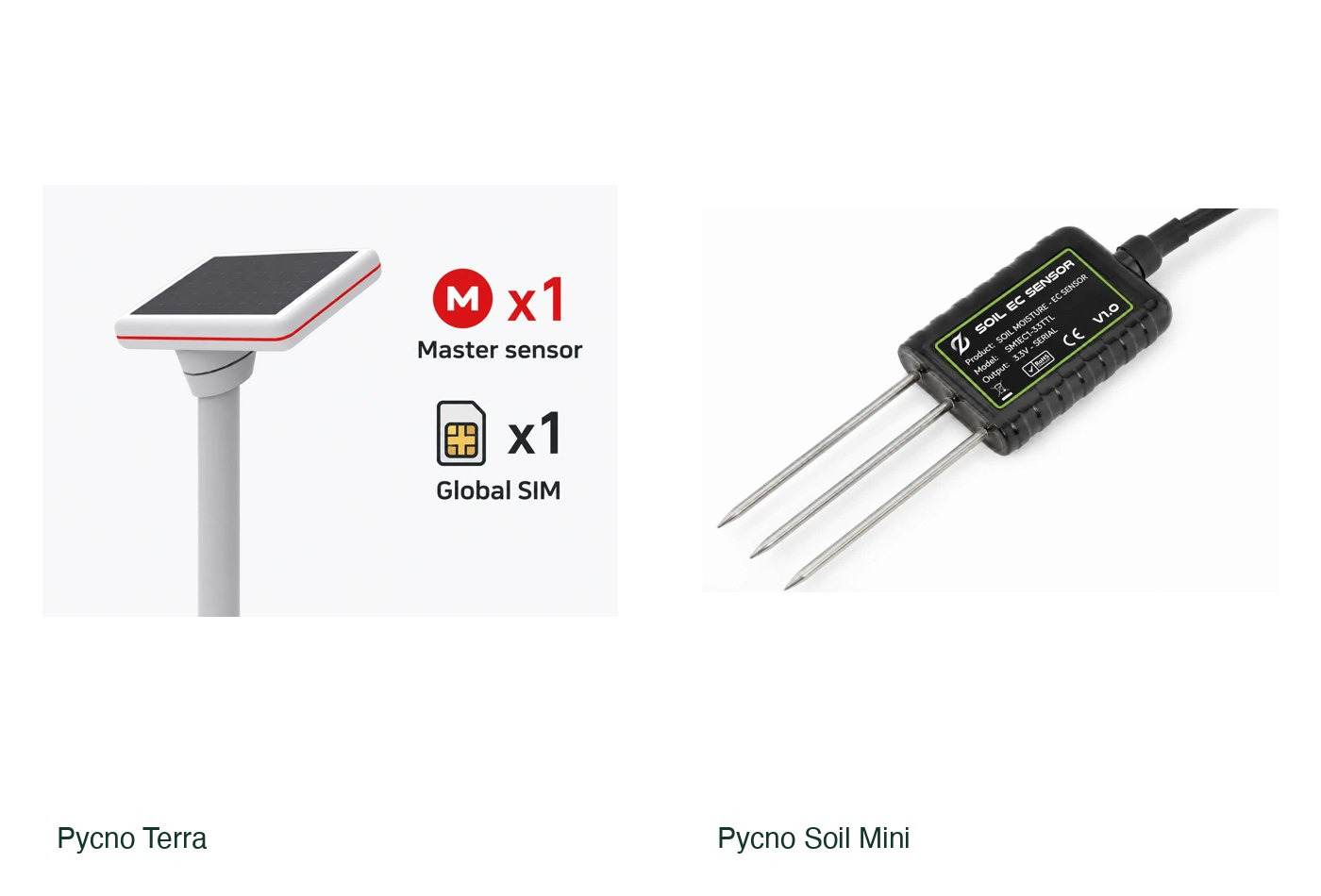
Pycno Terra
A strong starting point for growers who want an integrated soil-monitoring network. The Master handles cellular upload and can collect readings from compatible Nodes.
Choose Master/Node, depth, modem and local radio frequency before ordering.
View product details ↗Soil moisture and EC; selected wired interface
Pycno Soil Mini
A wired probe for installations requiring several shallow measurement points. The UART version uses a Pulse UART sliding module, while the RS-485 version uses its corresponding module.
Match the interface to the Pulse module; RS-485 and SDI-12 variants have different supply availability.
View product details ↗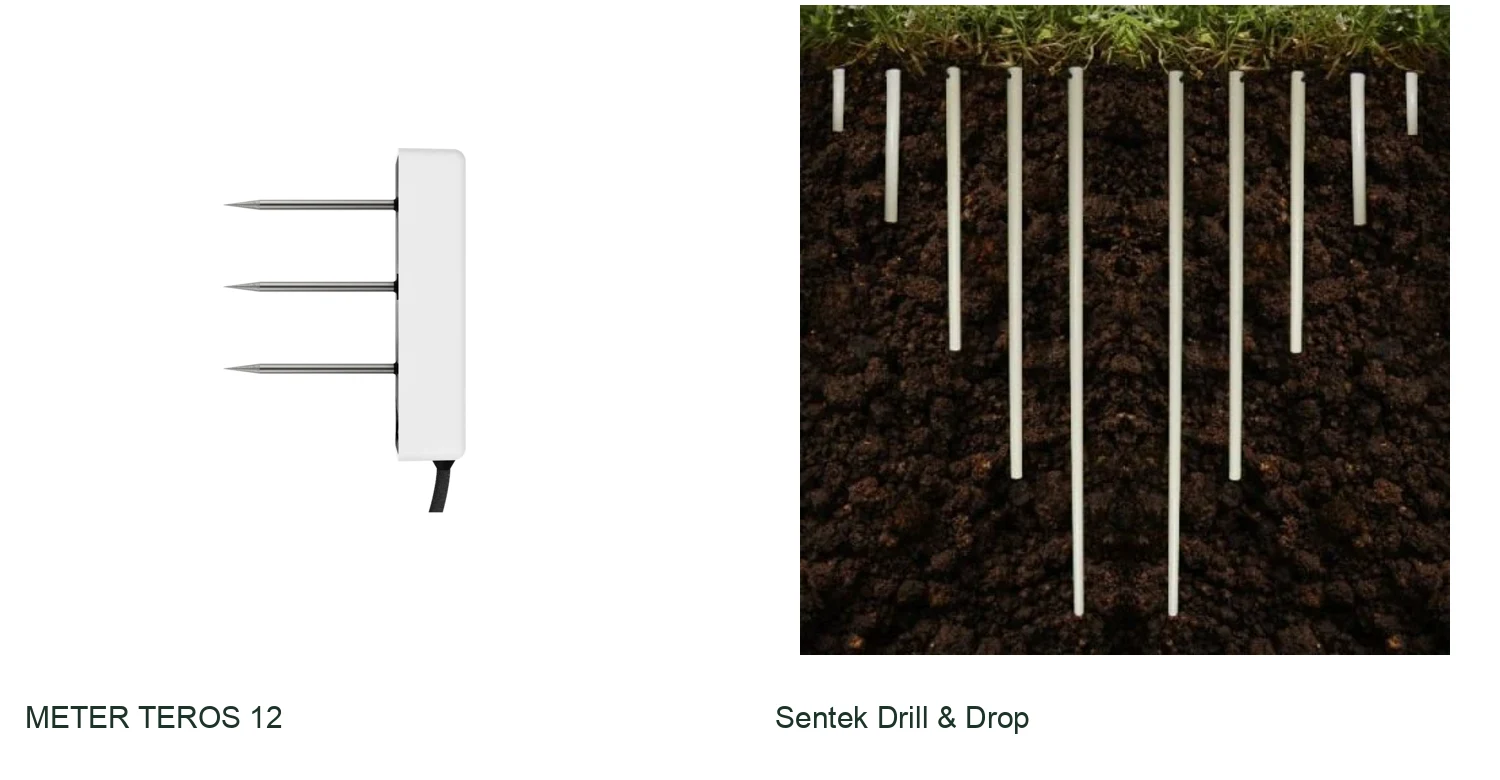
TEROS 12 wired probe
METER TEROS 12
A compact wired probe for growers and researchers who need water content, temperature and bulk electrical conductivity. It works with METER logging systems and compatible SDI-12 loggers.
Build multi-depth coverage with multiple probes; budget for logging and telemetry.
View product details ↗Multi-depth probe family; salinity optional
Sentek Drill & Drop
A profile probe for tracking conditions at several depths from one installation. The range is particularly relevant when deeper roots and water movement require more than a single-depth measurement.
Select the probe interface and data-transfer system together.
View product details ↗| Model | Measurement / role | Data connection | Coverage / installation |
|---|---|---|---|
| Pycno Terra | Soil moisture and soil temperature; ambient measurements also listed | Master uploads through cellular; Nodes use a Master | 30, 60 or 90 cm probe options; moisture modules at 15 cm intervals |
| Pycno Soil Mini | Soil moisture and electrical conductivity | 3.3 V UART, RS-485 or SDI-12 version | Local shallow measurement points |
| METER TEROS 12 | Volumetric water content, temperature and bulk EC | SDI-12; compatible logger required | One local measurement volume per installed probe |
| Sentek Drill & Drop | Soil moisture and temperature; salinity on equipped variants | SDI-12 or RS232/RS485 variants; matched telemetry required | 30–120 cm probes with sensing every 10 cm |
Installation and selection
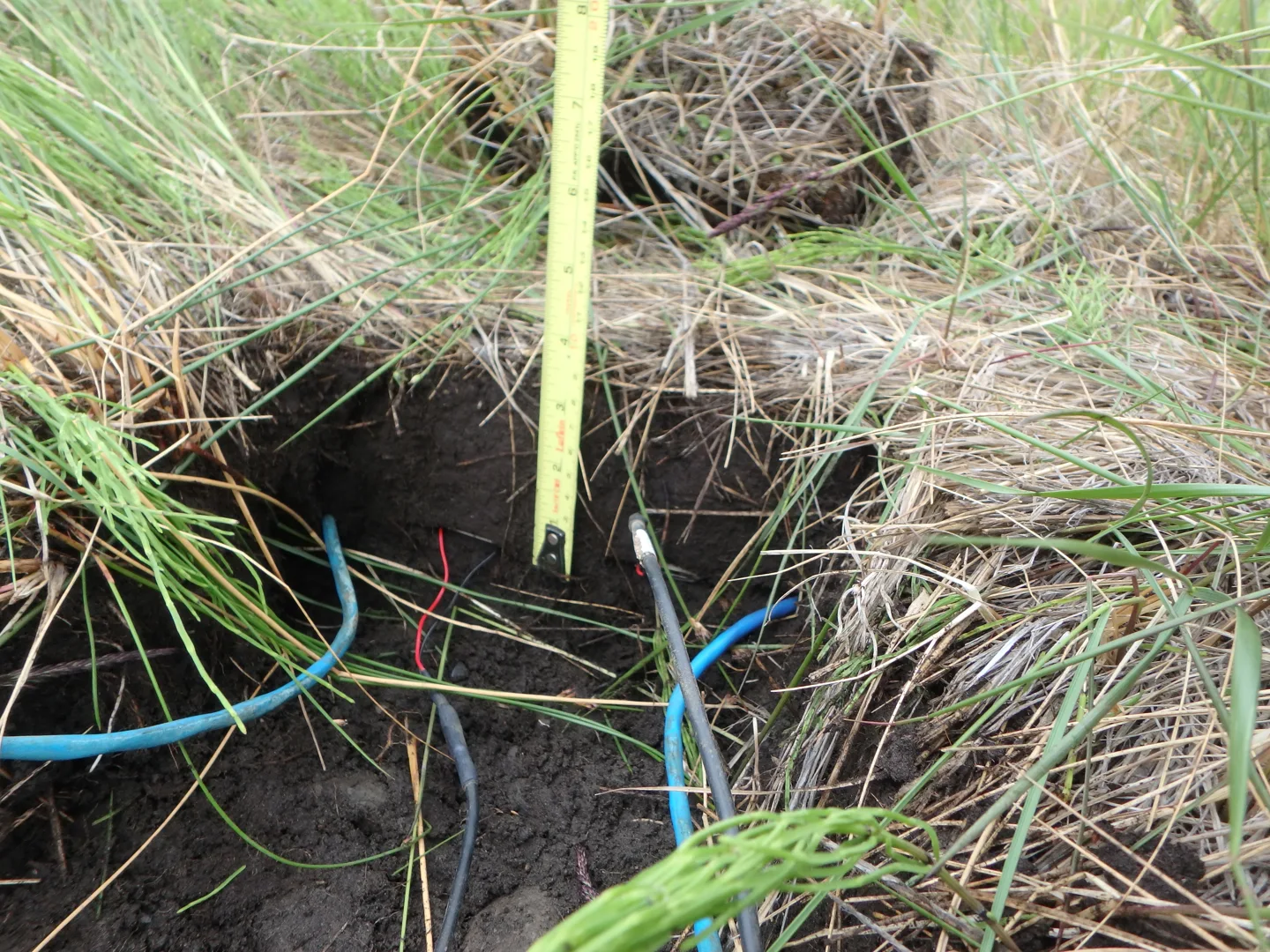
Probe depth, number of monitoring locations and Master placement should be specified together. A single profile can describe vertical changes at one position, but additional locations are needed where soil or irrigation management differs. Document the distance from emitters, soil horizons and crop rows.
Terra is a suitable starting point when integrated field telemetry and the Pycno analysis environment are priorities. A logger-based probe may be preferable when bulk electrical conductivity, an existing SDI-12 network or a research-specific calibration workflow is the central requirement. The decision depends on the complete installation rather than the probe alone.
Terminology
- Master
- The Terra configuration providing cellular upload and receiving observations from compatible Nodes.
- Node
- A Terra unit relying on compatible Master infrastructure for its data path.
- Measurement depth
- The installed vertical position represented by a sensing element, distinct from the total probe length.
Development of soil monitoring
Electronic soil instruments extended manual sampling and tension measurements with repeated observations and automated records. Profile probes add measurements at several depths, while telemetry makes the time series available remotely. Installation geometry and calibration continue to determine the meaning of those records.
Frequently asked questions
Does every Terra upload through cellular?
No. Cellular upload is associated with the Master configuration; Nodes use a compatible Master.
Does a 90 cm probe monitor a larger field area?
It extends vertical coverage at its installed location. It does not increase the horizontal soil volume represented by that location.
Is Soil Mini a smaller cellular Terra?
No. Soil Mini is a wired moisture and electrical-conductivity instrument with interface variants. It requires a compatible acquisition arrangement.