Measurement quantities
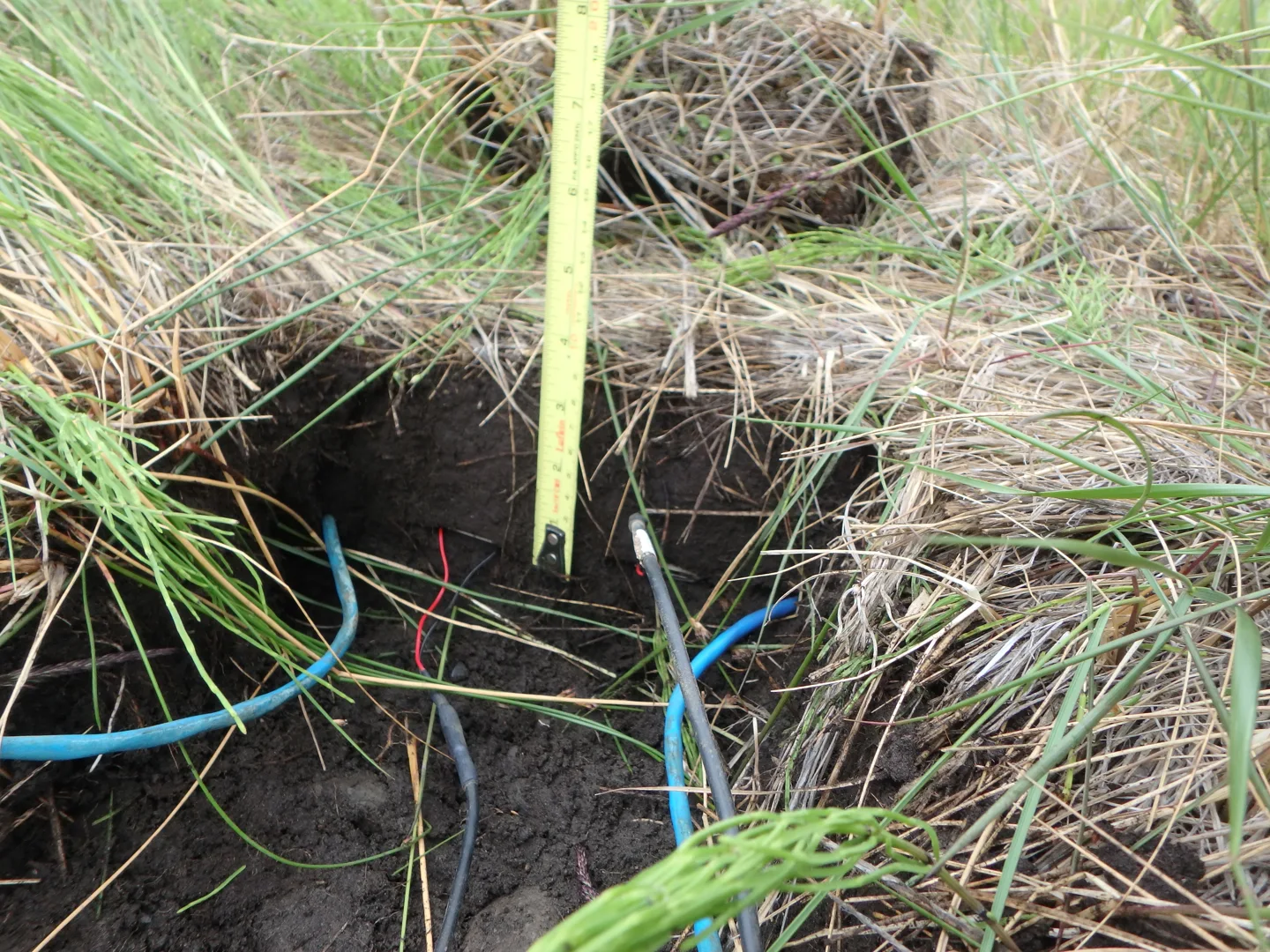
Soil-monitoring instruments differ first in what they measure. Volumetric water content describes water volume per unit bulk soil volume. Soil water potential describes the energy state of water, usually reported as negative potential or positive tension. Electrical conductivity describes conductive behaviour and can help interpret salinity, but bulk soil EC is not interchangeable with pore-water EC or a laboratory extract.
The same water content can correspond to different water tensions in different soils. Clay, sand and organic substrates have different water-retention relationships. A comparison should therefore begin with the quantity needed for irrigation management or agronomic analysis, followed by the installation and acquisition architecture.
Integrated networks and wired instruments
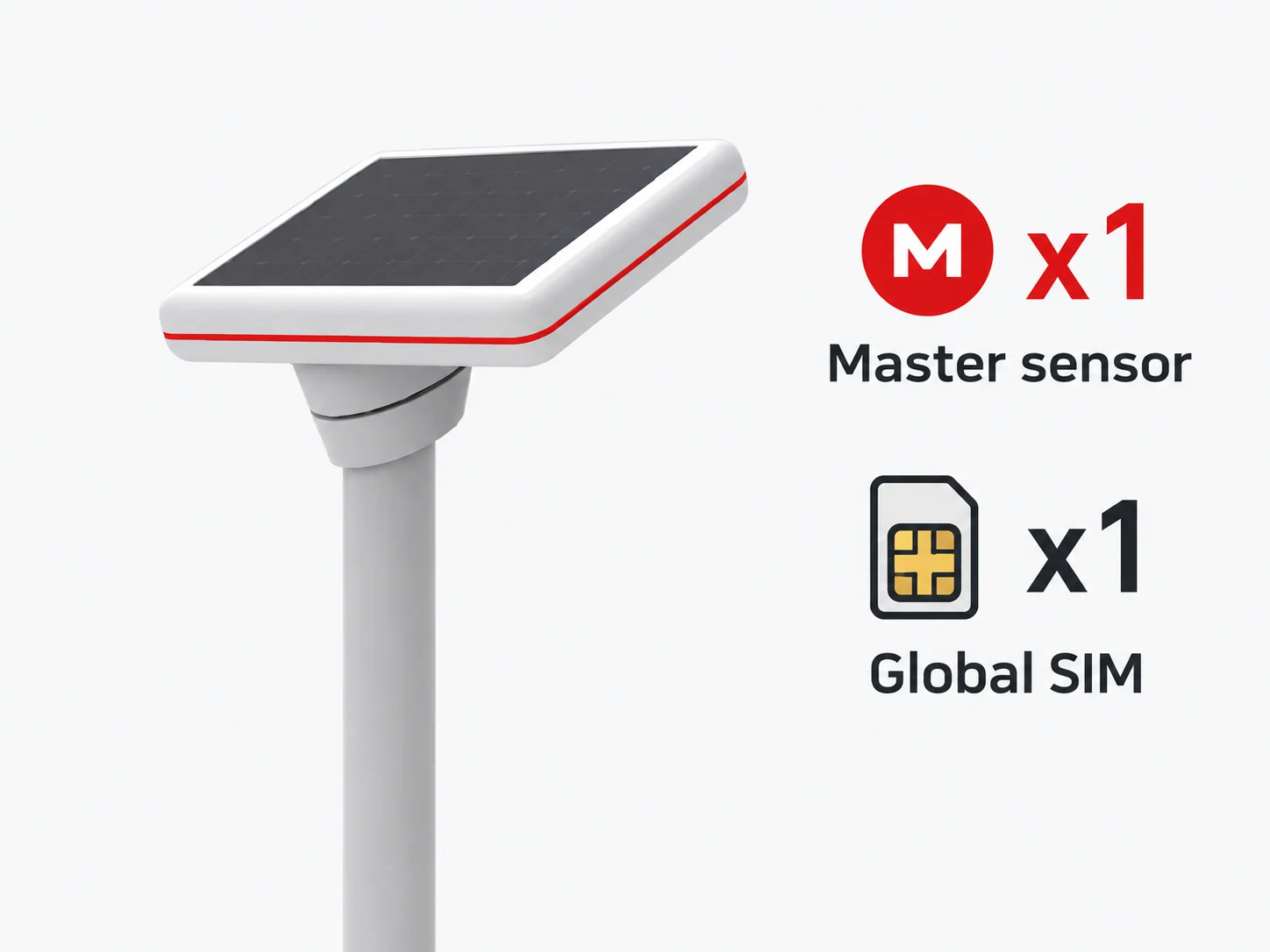
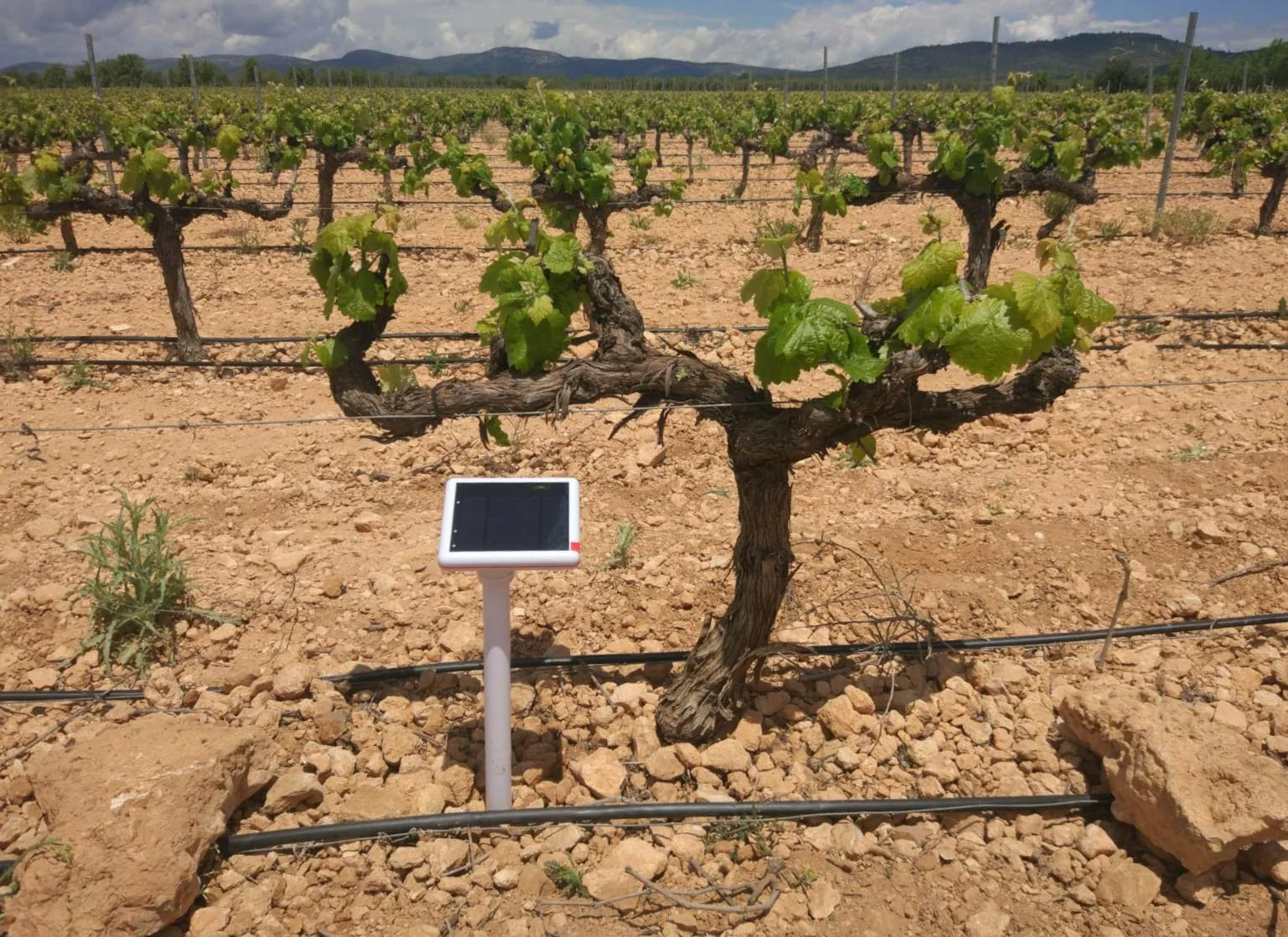
Integrated instruments combine sensing, power and communications. Pycno Terra provides multi-depth monitoring with a cellular Master and compatible radio Nodes. This reduces the number of separate components required to establish a field network and connects the measurements to the Pycno analysis platform.
Wired instruments require a logger, gateway or controller. Pycno Soil Mini provides moisture and EC sensing for shallow distributed positions, with selected UART, RS-485 or SDI-12 variants. It is relevant where a Pulse-based acquisition installation is planned, subject to matching the interface and power arrangement. TEROS 12 uses SDI-12, while Delta-T SM150T provides an analog moisture signal and a separate thermistor channel.
Sentek Drill & Drop measures at multiple positions along a profile. The selected probe, communication equipment and software configuration determine the delivered system. WATERMARK 200SS measures tension through a granular matrix, using a compatible resistance-reading circuit or adapter. These are different architectures rather than interchangeable probes.
Soil-monitoring instruments
The six models below cover integrated telemetry, shallow wired sensing, point dielectric measurements, multi-depth profiling and granular-matrix tension measurement.
Terra Master; Node version also offered
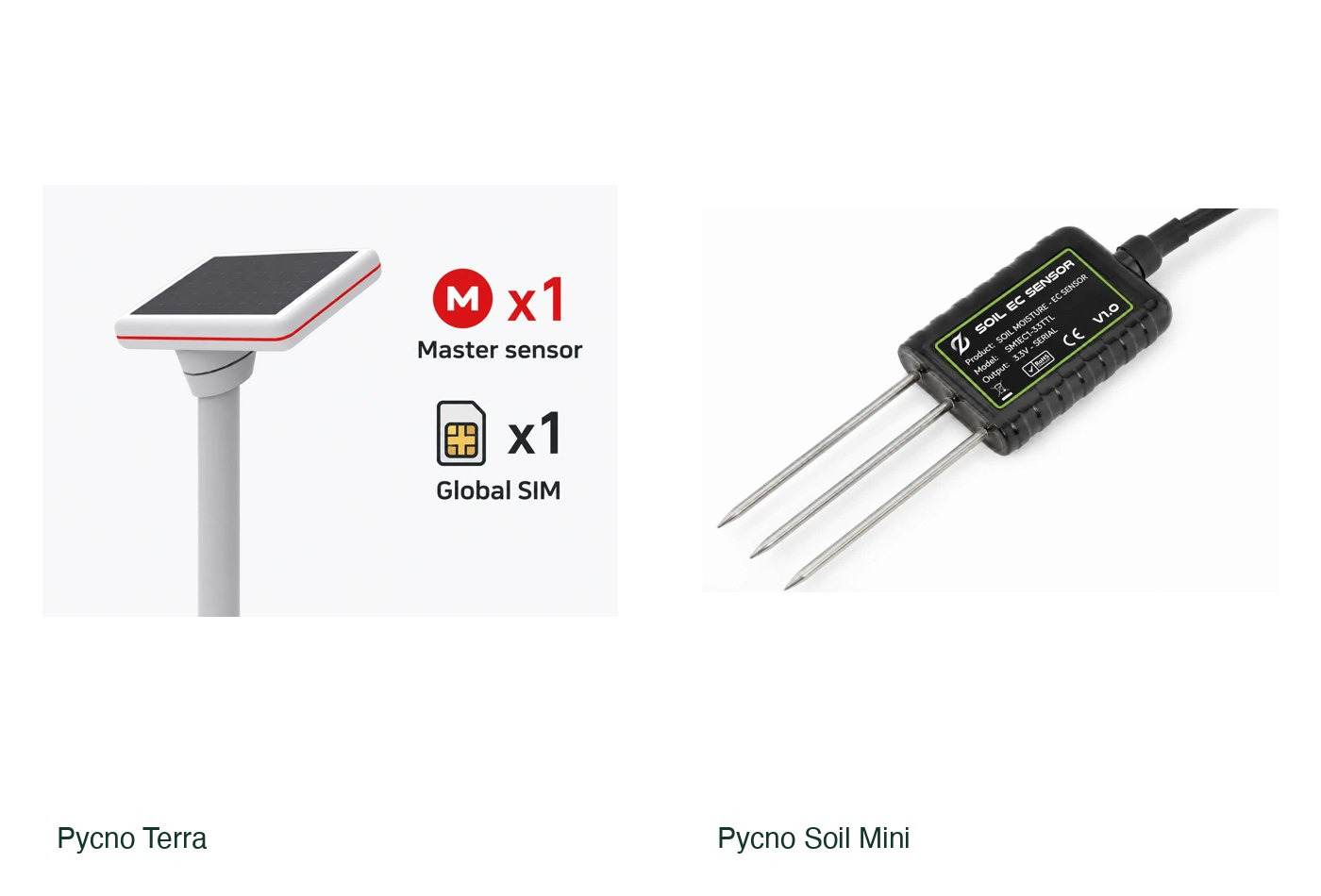
Pycno Terra
A strong starting point for growers who want an integrated soil-monitoring network. The Master handles cellular upload and can collect readings from compatible Nodes.
Choose Master/Node, depth, modem and local radio frequency before ordering.
View product details ↗Soil moisture and EC; selected wired interface
Pycno Soil Mini
A wired probe for installations requiring several shallow measurement points. The UART version uses a Pulse UART sliding module, while the RS-485 version uses its corresponding module.
Match the interface to the Pulse module; RS-485 and SDI-12 variants have different supply availability.
View product details ↗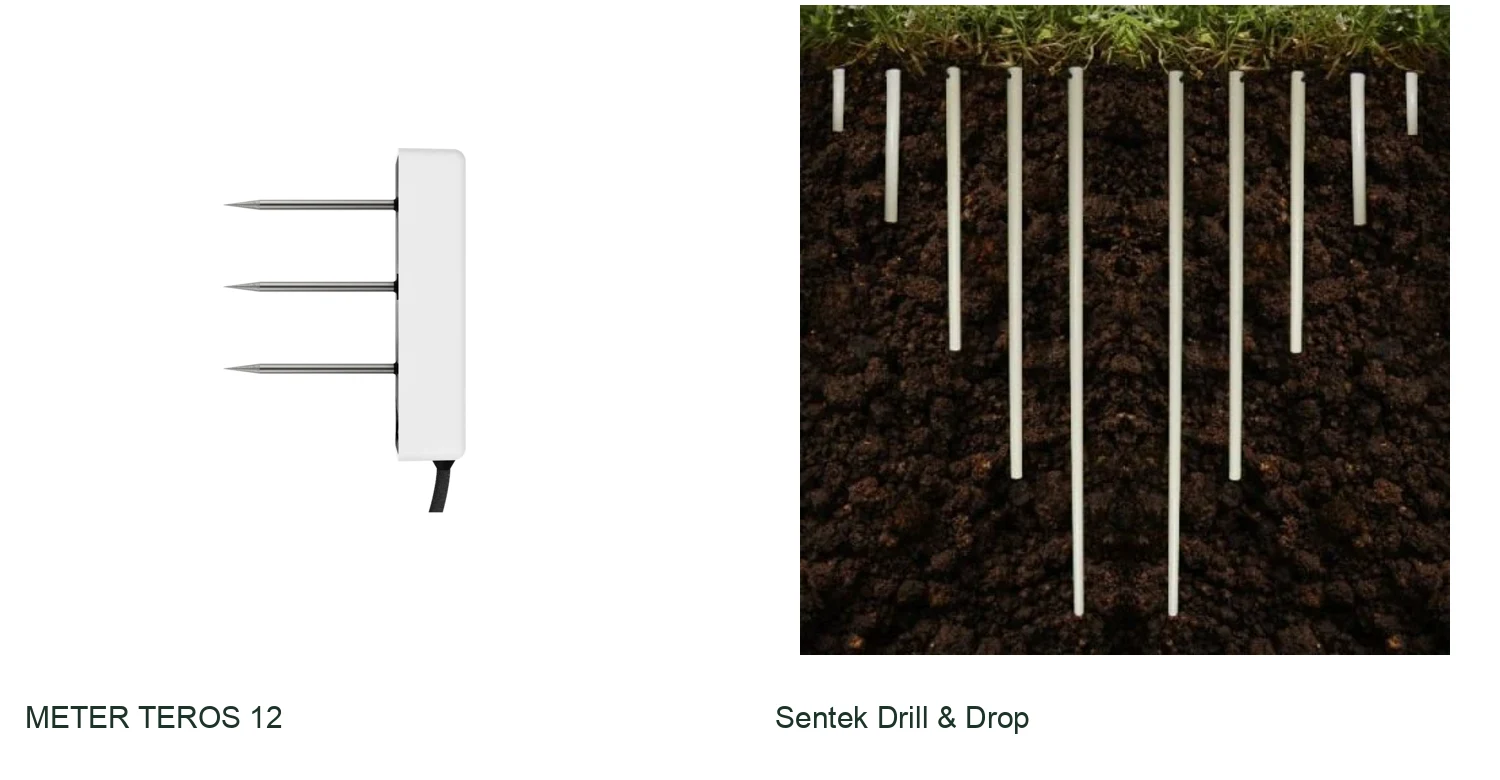
TEROS 12 wired probe
METER TEROS 12
A compact wired probe for growers and researchers who need water content, temperature and bulk electrical conductivity. It works with METER logging systems and compatible SDI-12 loggers.
Build multi-depth coverage with multiple probes; budget for logging and telemetry.
View product details ↗Multi-depth probe family; salinity optional
Sentek Drill & Drop
A profile probe for tracking conditions at several depths from one installation. The range is particularly relevant when deeper roots and water movement require more than a single-depth measurement.
Select the probe interface and data-transfer system together.
View product details ↗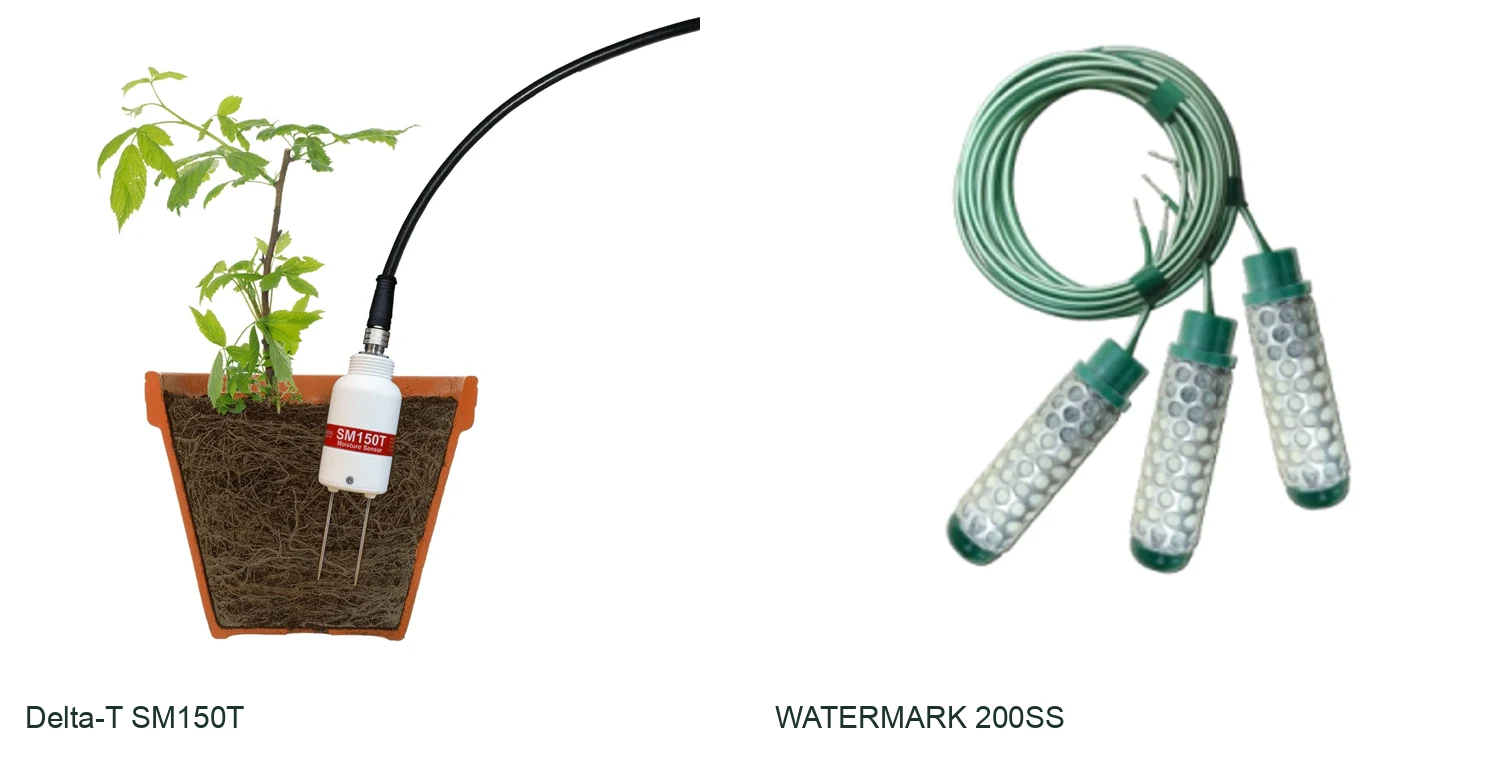
Delta-T SM150T
Delta-T SM150T
An analogue soil probe with a moisture output and a separate temperature channel. Calibration is selected for the monitored soil or substrate.
Temperature requires burial and a compatible logger; select calibration for soil or substrate.
View product details ↗IRROMETER WATERMARK 200SS
IRROMETER WATERMARK 200SS
A granular-matrix sensor that infers soil water tension from electrical resistance. Its readings require a compatible circuit and temperature treatment.
Temperature compensation and a compatible reading circuit are required; tension is not volumetric water content.
View product details ↗| Model | Measurement / role | Data connection | Coverage / installation |
|---|---|---|---|
| Pycno Terra | Soil moisture and soil temperature; ambient measurements also listed | Master uploads through cellular; Nodes use a Master | 30, 60 or 90 cm probe options; moisture modules at 15 cm intervals |
| Pycno Soil Mini | Soil moisture and electrical conductivity | 3.3 V UART, RS-485 or SDI-12 version | Local shallow measurement points |
| METER TEROS 12 | Volumetric water content, temperature and bulk EC | SDI-12; compatible logger required | One local measurement volume per installed probe |
| Sentek Drill & Drop | Soil moisture and temperature; salinity on equipped variants | SDI-12 or RS232/RS485 variants; matched telemetry required | 30–120 cm probes with sensing every 10 cm |
| Delta-T SM150T | Volumetric water content and temperature | 0–1 V moisture output; thermistor temperature channel | Local soil measurement volume |
| IRROMETER WATERMARK 200SS | Soil water tension | Resistance measurement; optional analog or SDI-12 adapter | Local soil measurement volume |
Calibration and measurement uncertainty
Published accuracy values are meaningful only with their units, calibration and test conditions. A water-content uncertainty expressed in m³/m³ cannot be ranked directly against a tension uncertainty expressed in kPa. Digital resolution indicates the available output increments, rather than the accuracy of the underlying field estimate.
Dielectric measurements respond to water because its electrical properties differ substantially from those of air and dry soil constituents. Soil-specific calibration can improve interpretation in media that differ from the factory calibration. Salinity and temperature can also affect the response. Sensor contact and the representativeness of the sampled volume remain important even where the electronics have a detailed specification.
Granular-matrix sensors equilibrate with surrounding soil water and convert resistance to tension through a calibration relationship. Temperature affects the reading. Rapid wetting, very dry conditions and the soil's hydraulic properties influence response time and suitability. The current WATERMARK overview and older datasheets differ in their stated upper range; the range and conversion supported by the selected reader should be confirmed.
Depth, field coverage and irrigation interpretation
Point instruments provide a local measurement volume. Multi-depth probes provide a vertical series at one position. Neither architecture eliminates the need to sample distinct management zones. Rooting depth, soil horizons and emitter geometry determine whether the measurements correspond to the crop's available water supply.
Measurements near the surface show short-term wetting and drying. Deeper readings can establish whether water has penetrated the active root zone or moved below it. Changes should be examined alongside irrigation duration, rainfall and crop development. Thresholds should be established for the site rather than transferred from a catalogue example.
Software and system ownership
A complete comparison includes the sensor, installation, logger or gateway, power, communications, software and maintenance. Terra with the Pycno platform is a coherent option where a field-to-dashboard system is required. The platform documents maps, alerts, visual analysis and spreadsheet export. Soil Mini is suited to a different arrangement in which wired acquisition is specified separately.
Logger-based systems may provide greater flexibility where a farm already has compatible infrastructure or needs a defined research workflow. Confirm timestamp handling, units, channel labels, export access and service terms. Recurring connectivity and software charges should be evaluated for the proposed package rather than inferred from the hardware price.
Selection by application
For routine profile monitoring with integrated telemetry, Terra merits consideration early in the system design. For several shallow positions around irrigated beds or protected crops, Soil Mini can provide a suitable wired arrangement. TEROS 12 is relevant where water content, temperature and bulk EC are needed through SDI-12. Drill & Drop addresses multi-depth profiling; SM150T supports analog acquisition; WATERMARK supports tension-based scheduling with an appropriate reader.
Long-term value depends on reliable installation, maintainable communications and interpretation consistent with the measured quantity. Instrument selection and the monitoring protocol should be specified together.
Terminology
- Dielectric measurement
- Inference of water content from the electrical response of the surrounding material.
- Granular matrix
- A porous sensing medium that exchanges water with the soil and supports resistance-based tension measurements.
- Water-retention relationship
- The relationship between water content and water potential for a specified soil and measurement method.
Development of soil monitoring
Electronic soil instruments extended manual sampling and tension measurements with repeated observations and automated records. Profile probes add measurements at several depths, while telemetry makes the time series available remotely. Installation geometry and calibration continue to determine the meaning of those records.
Frequently asked questions
Can tension and water content be converted?
A soil-specific water-retention relationship can connect them. There is no single conversion that applies to every soil and substrate.
Does electrical conductivity measure fertiliser concentration directly?
No. EC responds to conductive ions and measurement conditions. Nutrient composition requires additional information or analysis.
Must every probe have a cellular modem?
No. Wired probes use acquisition equipment, and radio Nodes can share a Master or gateway. The required infrastructure depends on the selected instrument.