Sap-flow instruments and dendrometers observe plant water transport and dimensional change. Their time series connect irrigation and weather with the response of individual stems, trees or fruits. The measurements are particularly useful in perennial crops, where a soil reading alone does not describe how the plant is using stored water.
Water transport, diameter and growth
Sap velocity describes the movement of water through conducting tissue, commonly expressed in cm/h. Sap flux density expresses flow per unit conducting area. Whole-stem flow, in L/h or kg/h, requires an integration across the active sapwood. A probe sampling two depths does not automatically measure the entire cross-section of a trunk.
A dendrometer records a change in stem, trunk or fruit dimensions. Diameter and displacement can be expressed in mm or µm. Reversible daytime contraction and overnight expansion reflect changing tissue hydration, while longer-term changes can include irreversible growth. Separating the two components requires an interpretation method and a stable installation; a single daily minimum is not a direct growth measurement.
Plant-level measurements should retain their sampling identity. The sensor position, stem size, variety, age and irrigation zone all matter when relating one plant to an orchard block. Replication across representative plants is more informative than assuming that a single instrumented tree expresses the behaviour of the entire field.
Sap-flow and displacement instruments
Heat-pulse probes, external heat-balance gauges, stem dendrometers and fruit dendrometers address different questions. Integrated advisory services can combine direct plant sensing with an interpretation platform, whereas research instruments may expose raw temperatures and displacement for independent analysis. These alternatives are grouped by measurement role.
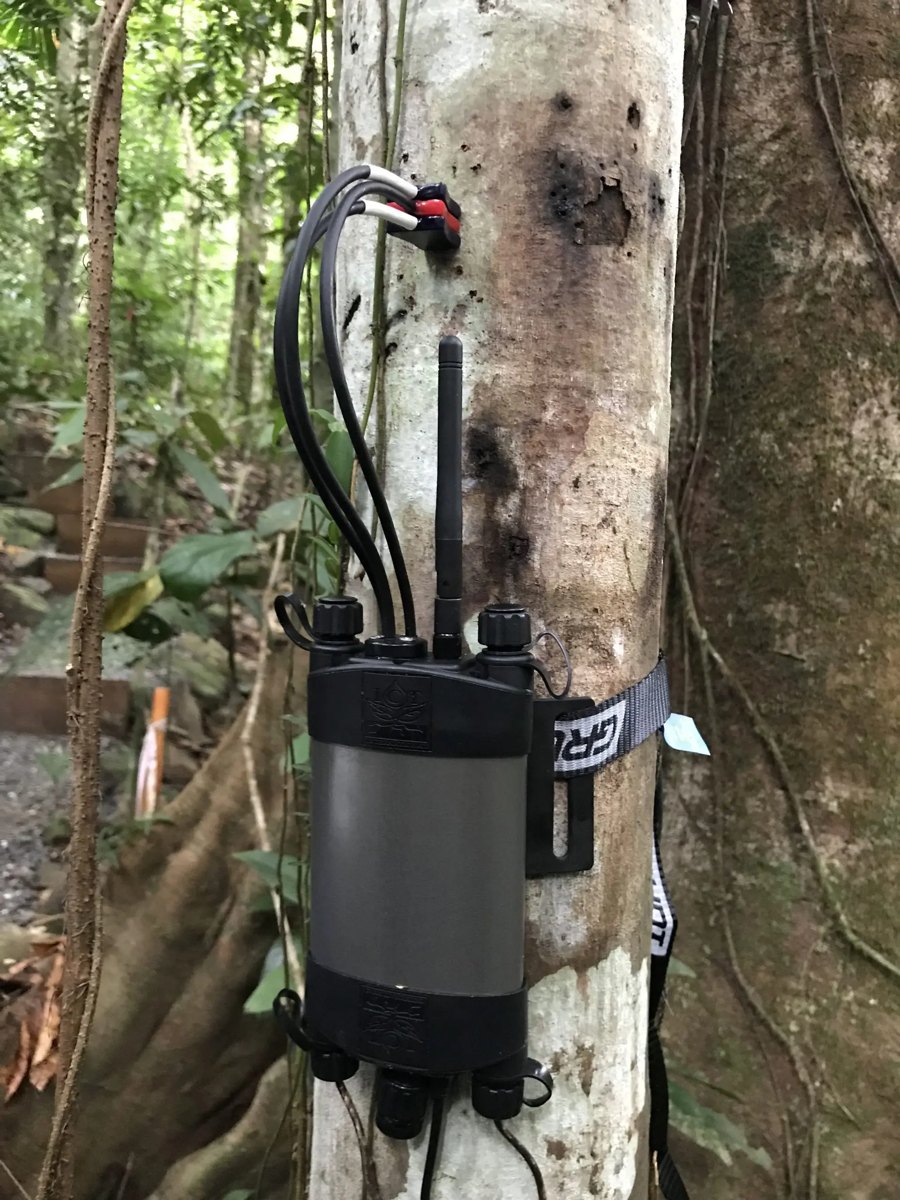
SFM1; SFM1x remote-access model is separate
ICT International SFM1
A self-contained heat-ratio instrument for sap movement, including low and reverse flow. It stores observations locally and calculates flow using installation-dependent parameters.
Sapwood properties, wound correction and radial variation affect flow scaling.
View product details ↗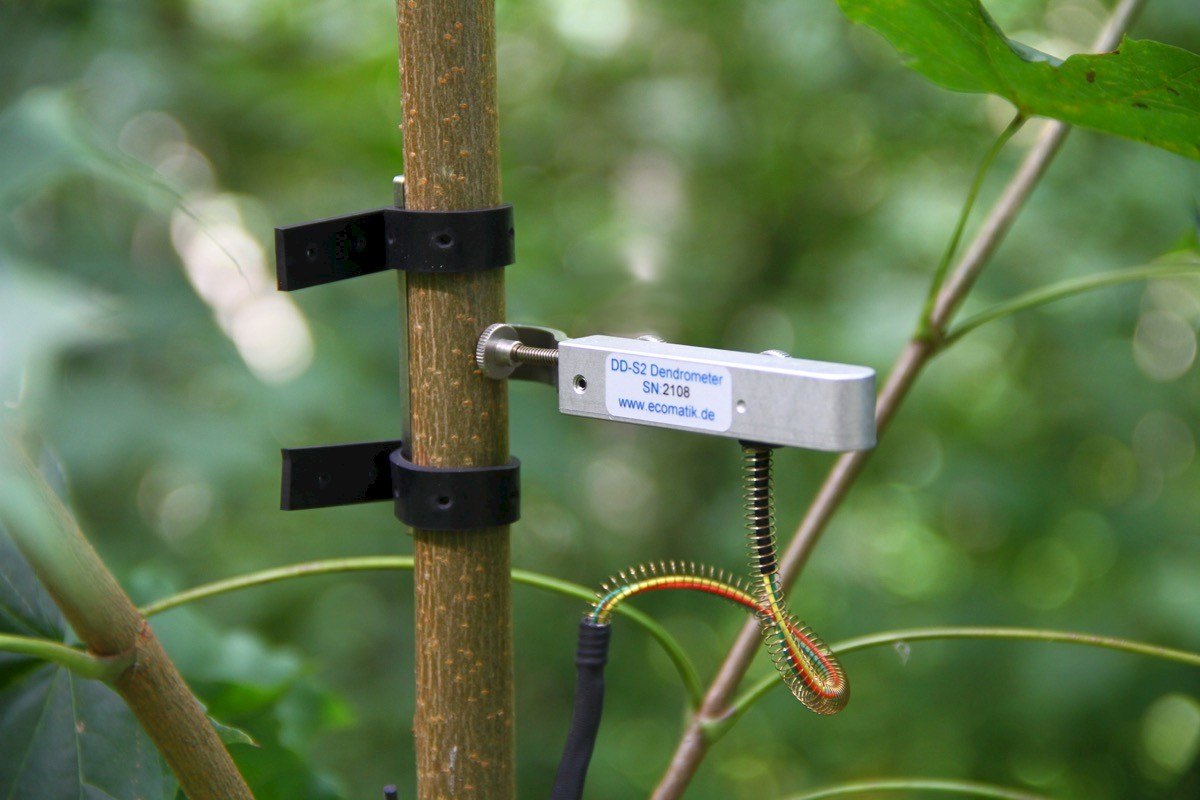
DD-S2; sealed DD-S2W is a separate variant
Ecomatik DD-S2
A small-stem diameter dendrometer with a quick-mount frame. It follows dimensional changes without needle insertion and requires a compatible acquisition system.
Distinguish frame travel from stem-size range; logging and thermal response influence the result.
View product details ↗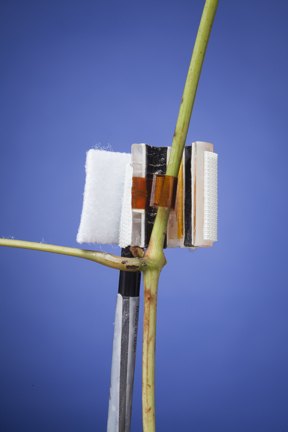
Dynagage family; gauge diameter selected at order
Dynamax Dynagage
External gauges measure the heat carried by sap through an instrumented stem. The product family provides multiple sizes, which must be selected for the sampled plant.
Gauge fit, insulation and heat-loss treatment remain essential.
View product details ↗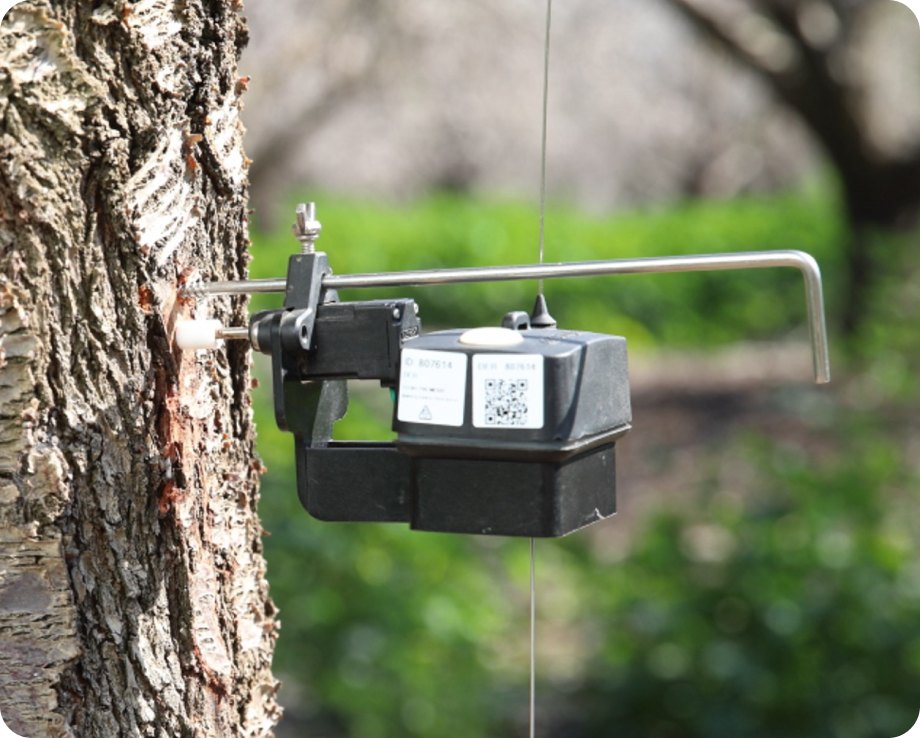
Plant-sensing service; installed generation specified in proposal
Phytech plant-sensing system
A connected plant-sensing service combining dendrometer observations with crop-status interpretation. Procurement covers the sensor deployment and platform rather than a standalone raw-displacement instrument alone.
Confirm regional service, deployment density and data access; platform indicators are interpreted outputs.
View product details ↗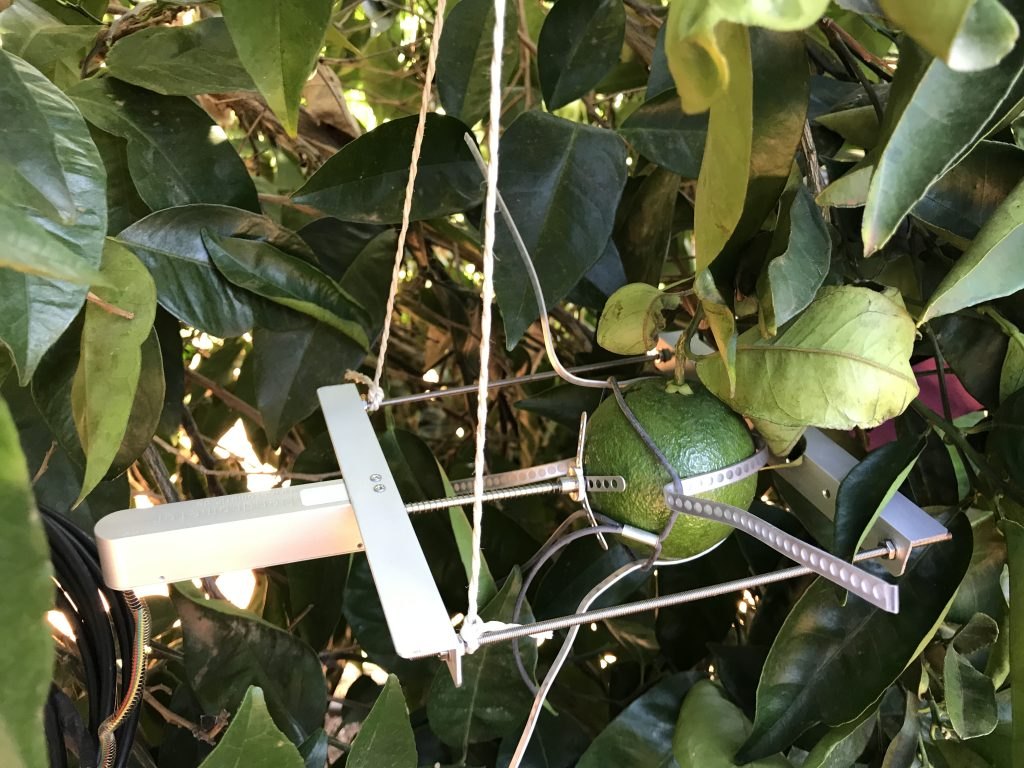
DF1, DF2 and DF3 fruit-dendrometer family
Ecomatik DF fruit dendrometers
A fruit-size instrument distributed by ICT International and manufactured by Ecomatik. The DF2 configuration follows dimensional change over a defined measuring travel.
Support sensor weight and cable tension; fruit hydration and growth contribute to the trace.
View product details ↗| Model | Measurement / role | Data connection | Coverage / installation |
|---|---|---|---|
| ICT International SFM1 | Heat-pulse velocity, sap velocity and calculated sap flow | Onboard microSD logging; USB access | Inserted needles; two depths per measurement needle |
| Ecomatik DD-S2 | Changes in stem diameter | Compatible analogue logger; digital options model dependent | Small stems below 5 cm diameter; 11 mm measuring travel |
| Dynamax Dynagage | Sap mass flow using stem heat balance | Compatible Dynamax logging or sap-flow system | External gauge selected to match stem diameter |
| Phytech plant-sensing system | Stem-dimensional response with platform interpretation | Connected Phytech service | Selected plants within orchard blocks |
| Ecomatik DF fruit dendrometers | Fruit dimensional change | Bare-ended sensor cable to compatible acquisition | Standard fruit diameter below 11 cm; 25 mm measuring travel |
Heat-pulse and heat-balance methods
A heat-pulse instrument applies a short thermal input and measures its propagation through the stem. In the heat-ratio method, temperature responses upstream and downstream of the heater provide information about low flow and its direction. Probe spacing, thermal properties and installation alignment enter the calculation. Needle insertion also disturbs conducting tissue, so wound corrections are part of the method rather than an optional cosmetic adjustment.
Burgess and colleagues published an improved heat-pulse method in 2001 for low and reverse sap flow in woody plants. Its ability to distinguish flow direction is relevant to water redistribution and research near low-flow conditions. It does not remove the need to identify active sapwood depth or account for radial differences in transport.
External heat-balance gauges wrap around a suitable stem and account for the heat supplied, conducted and carried away by moving sap. They avoid inserting probes into the measured stem, but need the correct gauge size, insulation and sound thermal contact. The residual heat transported by sap is converted into a mass-flow estimate. “No empirical calibration” describes the measurement principle; installation and heat-loss parameters still need appropriate treatment.
Interpreting stem and fruit displacement
A diameter dendrometer measures across the stem, while a point dendrometer measures local radial displacement against a support. Their mechanical geometry changes the meaning of the output. Circumference, diameter and radius are different quantities and should not share a threshold without conversion and knowledge of the mounting arrangement.
Temperature changes can expand both the plant and the instrument frame. Bark movement, slippage, wind and cable tension can create abrupt changes unrelated to growth. The instrument needs a stable contact force and enough measurement travel for the intended period. On small plants or fruits, an independent support may be needed to prevent the sensor's weight from altering the sample.
Maximum daily shrinkage is a difference between a day's maximum and minimum dimension, not the amount of permanent growth lost. Compare it with atmospheric demand, irrigation events and a reference period appropriate to the crop. Fruit expansion also depends on developmental stage and carbon supply; a diameter trace is not a direct measure of yield or final market grade.
Installation and data interpretation
Sap-flow installations require the correct drill guides, probe alignment and protection from external thermal gradients. Record the measured stem dimensions and the assumed sapwood properties. Dendrometers need periodic checks for travel limits, mounting stability and interference with developing tissue. Maintenance events belong in the data record because a reset can otherwise resemble a physiological response.
Compare plant observations with soil-water measurements, local weather and irrigation timing. A soil profile may remain wet while roots have limited access to water, or a plant may draw on deeper storage that a shallow probe does not observe. Those differences are useful diagnostic information. They should not be averaged away merely because the instruments disagree.
Reporting block-scale water use from a small sensor network requires an explicit scaling method. Plant density, canopy variation and measured-plant selection affect that estimate. Retaining individual traces, alongside an aggregate, makes it possible to detect damaged probes or a tree responding differently from its neighbours.
Terminology
- Heat ratio
- A relationship between temperature rises on opposite sides of a heater used to calculate heat-pulse movement.
- Active sapwood
- The conducting portion of woody tissue used in scaling local sap measurements.
- Maximum daily shrinkage
- The difference between the maximum and minimum stem dimension within a defined day.
- Dendrometer travel
- The displacement range available before the instrument requires adjustment.
Questions about direct plant measurements
Can one sap-flow sensor determine irrigation volume for an orchard?
It characterises the instrumented plant. Block estimates require representative sampling and scaling, together with irrigation efficiency and soil-water information.
Does overnight stem expansion mean new growth?
It can include rehydration. Growth analysis separates reversible water-related change from persistent dimensional increase over the relevant period.