Canopy temperature reflects the balance between absorbed radiation, heat exchange and evaporative cooling. Infrared instruments can follow that balance without contacting the leaves, helping assess crop-water response and locate differences within an irrigation zone. A temperature observation becomes informative when paired with the atmospheric conditions and the vegetation actually within the field of view.
How infrared temperature measurement works
An infrared radiometer detects thermal radiation from its target. Its calculation uses the instrument's detector temperature, calibration and assumptions about the target's emissivity and surrounding radiation. Dedicated canopy instruments commonly operate within the 8–14 µm atmospheric window. A spot radiometer integrates a single footprint; a thermal camera produces a grid of pixels that can distinguish leaves, soil and other objects when spatial resolution is sufficient.
Emissivity describes how effectively a surface emits thermal radiation relative to a blackbody at the same temperature. An incorrect emissivity setting or reflected-temperature assumption shifts the inferred temperature. A thermal camera's displayed thermal sensitivity is not the same as absolute temperature accuracy. Small differences can appear clearly in an image even when the absolute temperature uncertainty is appreciably larger.
The detector observes surface temperature rather than root-zone water content. A crop can reduce transpiration after inadequate irrigation, but also in response to high atmospheric demand, disease or root restrictions. Thermal measurements therefore complement soil-water observations and irrigation records rather than substituting for them.
Radiometers, cameras and crop-monitoring stations
These systems occupy different measurement roles. A dedicated crop radiometer is suitable for a fixed, well-defined canopy view. A general-purpose pyrometer requires an agricultural mounting and logging arrangement. A handheld camera supports spatial inspection, while an integrated field monitor brings canopy observations together with local weather. Their outputs should be compared at the level of the intended observation, rather than treated as interchangeable irrigation controllers.
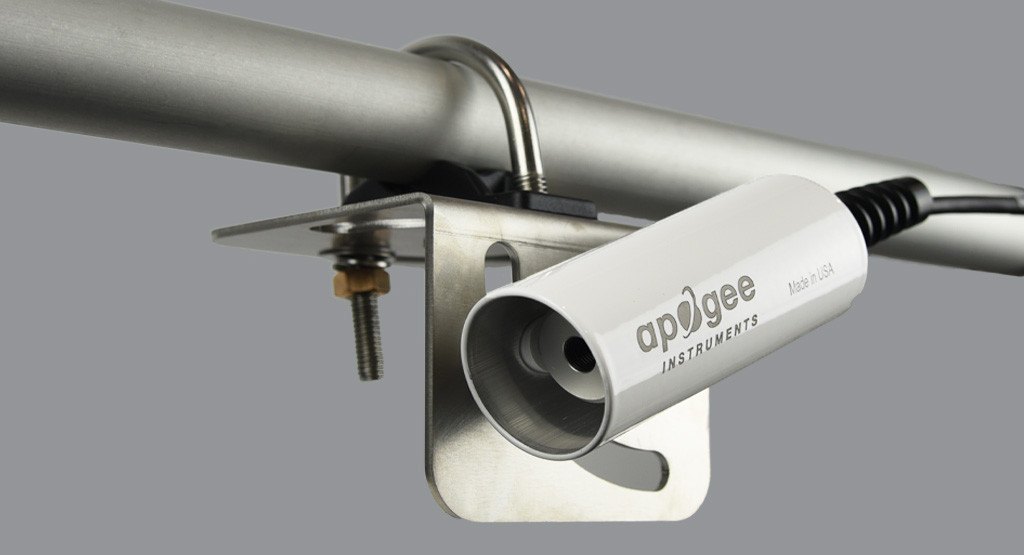
SI-111-SS analogue variant
Apogee SI-111-SS
A dedicated radiometer used for canopy temperature and surface energy-balance observations. The specified 22° half-angle defines a footprint that must remain predominantly vegetation.
Requires appropriate analogue measurement, canopy coverage and stable mounting.
View product details ↗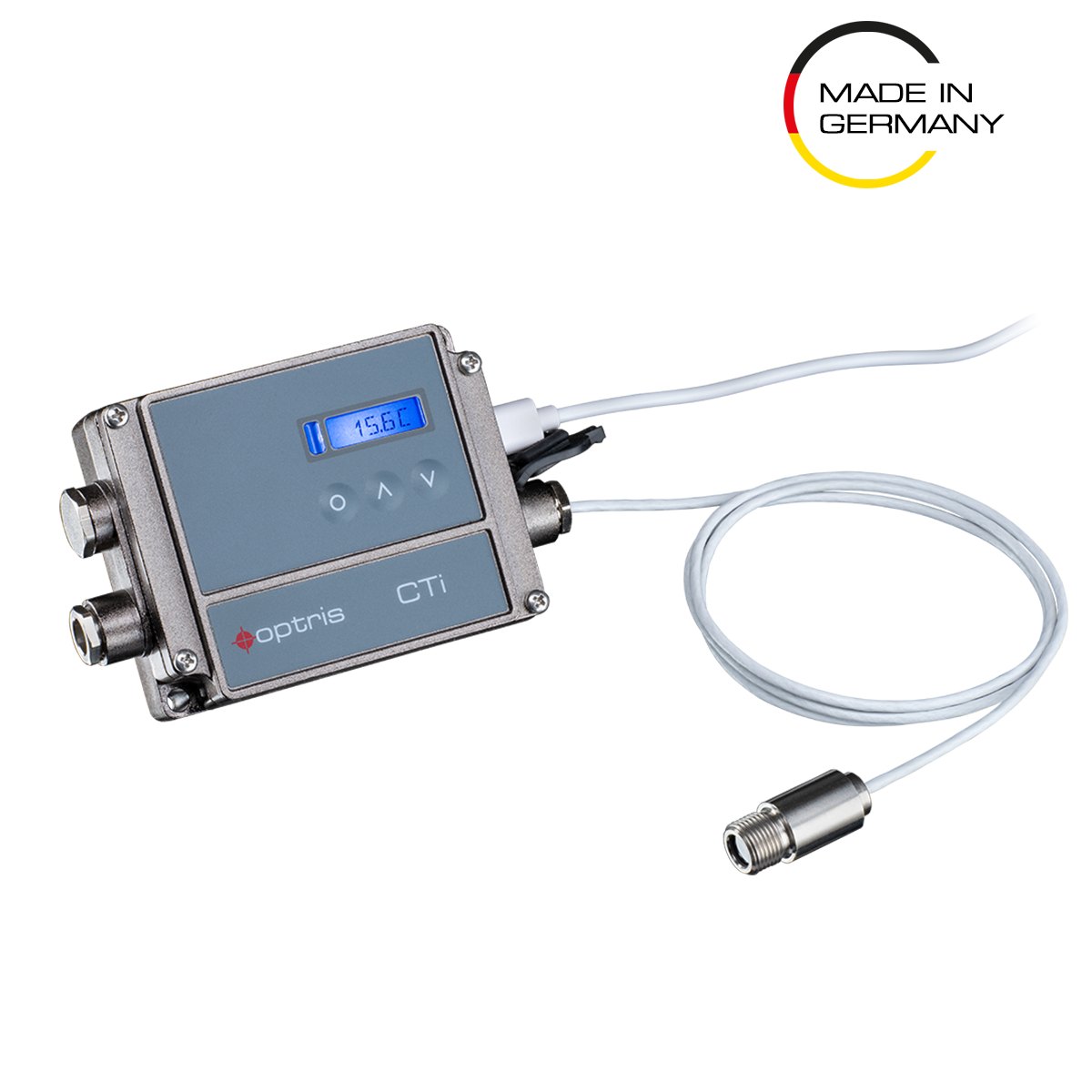
CTi LT series; select optics and interface
Optris CTi LT
A compact industrial infrared pyrometer for high-emissivity, low-temperature targets. Its point observation can form part of a customised crop installation when optics and integration are appropriately specified.
An industrial instrument needs a crop-specific mounting, acquisition and interpretation arrangement.
View product details ↗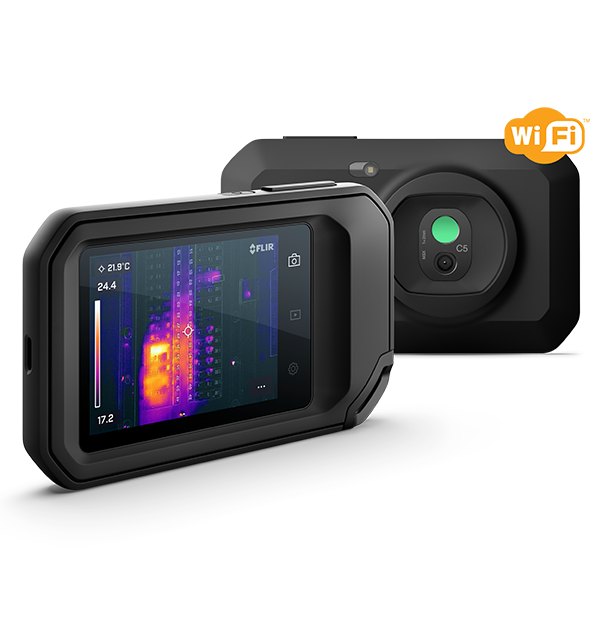
C5 handheld thermal camera
FLIR C5
A compact thermal camera producing spatial temperature observations. It is a survey instrument rather than a complete continuous crop-water monitoring station.
A general-purpose inspection camera; absolute accuracy and mixed pixels limit fine crop comparisons.
View product details ↗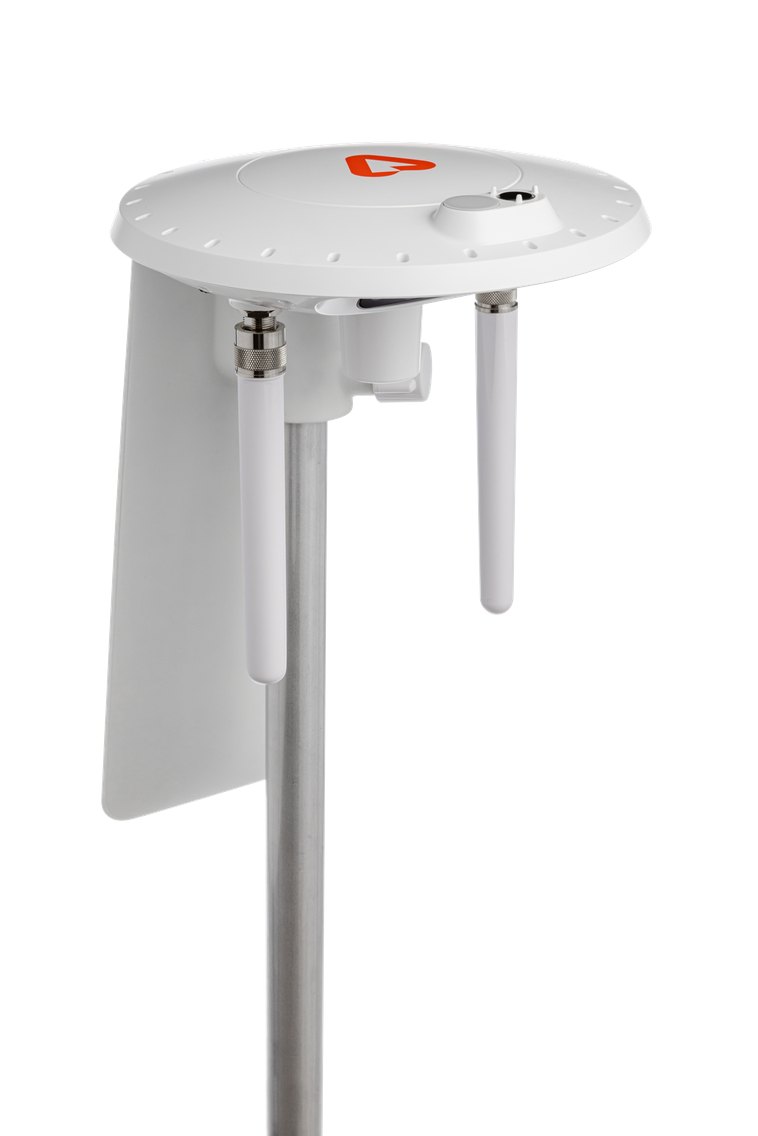
Mark 3; optional soil measurements require associated equipment
Arable Mark 3
An integrated field monitor that brings canopy temperature together with weather and crop observations. Its daily crop camera provides additional context for interpreting changes.
Service scope, installation and the canopy viewed by the station are part of procurement.
View product details ↗| Model | Measurement / role | Data connection | Coverage / installation |
|---|---|---|---|
| Apogee SI-111-SS | Surface temperature from thermal infrared, 8–14 µm | Unamplified analogue outputs to suitable logger | 22° half-angle field of view |
| Optris CTi LT | Infrared surface temperature, 8–14 µm | Industrial pyrometer integration; output/options vary | Point measurement; optics/configuration selected at order |
| FLIR C5 | Radiometric thermal images | Stored images and camera connectivity | 160 × 120 thermal detector; handheld inspection |
| Arable Mark 3 | Canopy temperature alongside crop and weather observations | Arable connected platform and service | Fixed in-field crop view |
Field of view and canopy coverage
For a circular view with half-angle θ and perpendicular target distance d, the nominal diameter is 2d tan(θ). With a 22° half-angle at 1 m, this gives approximately 0.81 m. The footprint becomes an ellipse when the view is oblique, and the instrument's specified angular response can extend beyond a simple geometric boundary.
Exposed soil, irrigation equipment and gaps between rows contribute radiation if they enter that footprint. Bare soil heated by sunlight can elevate an integrated reading even while the leaves remain cool. Aim the instrument at a representative part of the canopy and reassess its position as plants develop. A fixed instrument must also remain clear of poles, cables and foliage growing directly against the window.
For camera surveys, the visible image helps document what each thermal region contains. Mixed pixels near leaf edges combine more than one surface. Focus, distance, viewing angle and a consistent region-of-interest definition are important when comparing sessions. An image captured after a cloud passes does not represent the same energy balance as one captured under sustained full sunlight.
Canopy-air difference and stress indices
The canopy-air temperature difference, Tc − Ta, is expressed in °C or K. If canopy temperature is 28°C and air temperature is 31°C, the difference is −3°C. That value describes cooling relative to the air; its agronomic meaning depends on radiation, wind, humidity and crop characteristics.
A crop water stress index normalises a temperature response between defined wet and dry references or modelled limits. The choice of baseline is part of the method. Thresholds derived for one crop and environment should retain those conditions when applied elsewhere. Weather instruments used in the calculation must represent the same site and time interval as the canopy measurement.
In 1981, Idso and colleagues developed an approach relating foliage-air temperature difference to atmospheric vapour pressure deficit under specified conditions, with experiments including squash, alfalfa and soybean. That work helped establish the rationale for normalisation. Contemporary systems may use additional measured variables and proprietary models, so an output called “stress” does not necessarily reproduce the same historical method.
Measurement quality and maintenance
Inspect optical windows for dust, water droplets, insects and residue. Log sensor orientation and mounting height alongside maintenance events. Compare a changed temperature pattern with irrigation timing, weather and field inspection before altering a control threshold. Data gaps and movements of the instrument should be visible in the time series.
Blackbody reference checks assess instrument response under controlled conditions. They do not reproduce a mixed canopy or validate a crop-water model. For a monitoring installation, weatherproofing, power, logger compatibility and stable mounting are separate procurement requirements from the thermal detector itself.
Terminology
- Emissivity
- The ratio of emitted radiation to blackbody emission at the same temperature and wavelength.
- Field of view
- The angular region contributing to a radiometer's observation.
- CWSI
- Crop water stress index, calculated against method-specific reference limits.
- Thermal sensitivity
- An instrument's ability to resolve small temperature differences; often stated as noise-equivalent temperature difference.
Questions about crop temperature
Is a warmer canopy always short of soil water?
No. Temperature reflects atmospheric demand, radiation and the crop's ability to transpire. Soil observations and crop condition help identify the cause of reduced cooling.
Can a handheld camera provide continuous irrigation feedback?
A handheld survey provides observations at the time of inspection. Continuous feedback requires fixed monitoring, suitable logging and a validated interpretation method.