Separate the agronomic rate from machine control
Variable-rate application changes an input rate as a machine moves through the field. A prescription map or live sensor can provide the target; a controller commands the meter, pump or valve; feedback indicates what the hardware delivered. These are separate decisions. A technically capable controller cannot establish whether a fertiliser rate is appropriate for the crop.
Start with one input and a defined objective. Variable-rate seeding, granular spreading and liquid application need different actuators and feedback. Turning a section off over previously treated ground is section control. Adjusting the amount applied within a working section is rate control. A system may offer both, but one capability does not imply the other.
From a map cell to an application record
A position receiver places the implement in a prescription zone. The controller reads its target, combines that with speed and active width, and calculates the required delivery. An electric motor may change seed-meter speed; a hydraulic drive may turn a fertiliser conveyor; a valve or pump may change liquid flow. Closed-loop control uses a measured response to correct the command.
Response time matters at zone boundaries. Material needs time to travel from its metering point to the ground, and an implement may trail several metres behind the antenna. Offset, look-ahead and on/off delay settings align the treatment with its intended location. The recorded applied-rate layer should distinguish target rate from measured delivery wherever the equipment supports it.
Five control approaches for different implements
These systems are alternative control architectures, not interchangeable packages. Field-IQ and IntelliAg cover several implement types with matched components. Ag Leader Granular targets dry product applications. Raven RCM supports different liquid, granular and seeding configurations. vDrive is a row-level electric seed-meter drive with its own display and compatibility requirements.
Crop input control system with selected modules
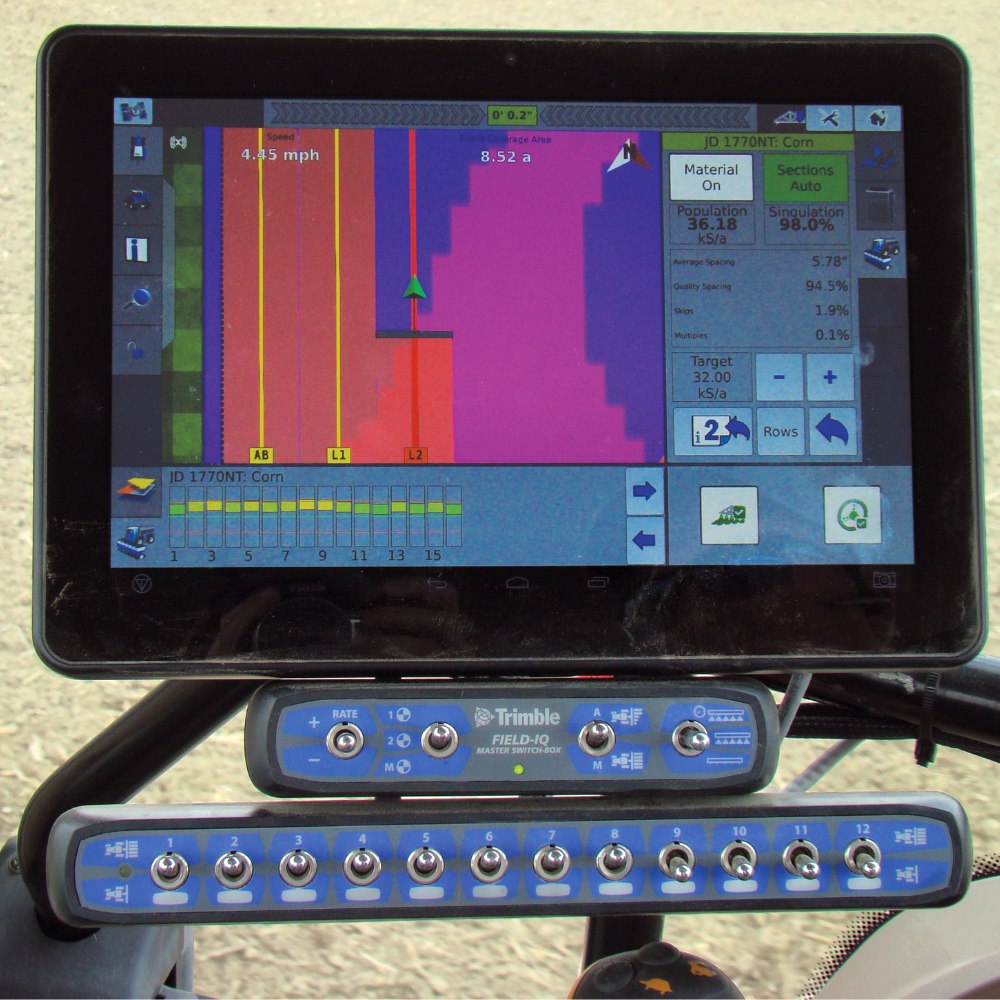
PTx Trimble Field-IQ
A crop-input system covering several application types with suitable components. It can combine rate control, section control and seed monitoring according to the installed package.
Select modules, drives, valves and display together; functions differ by configuration.
View product details ↗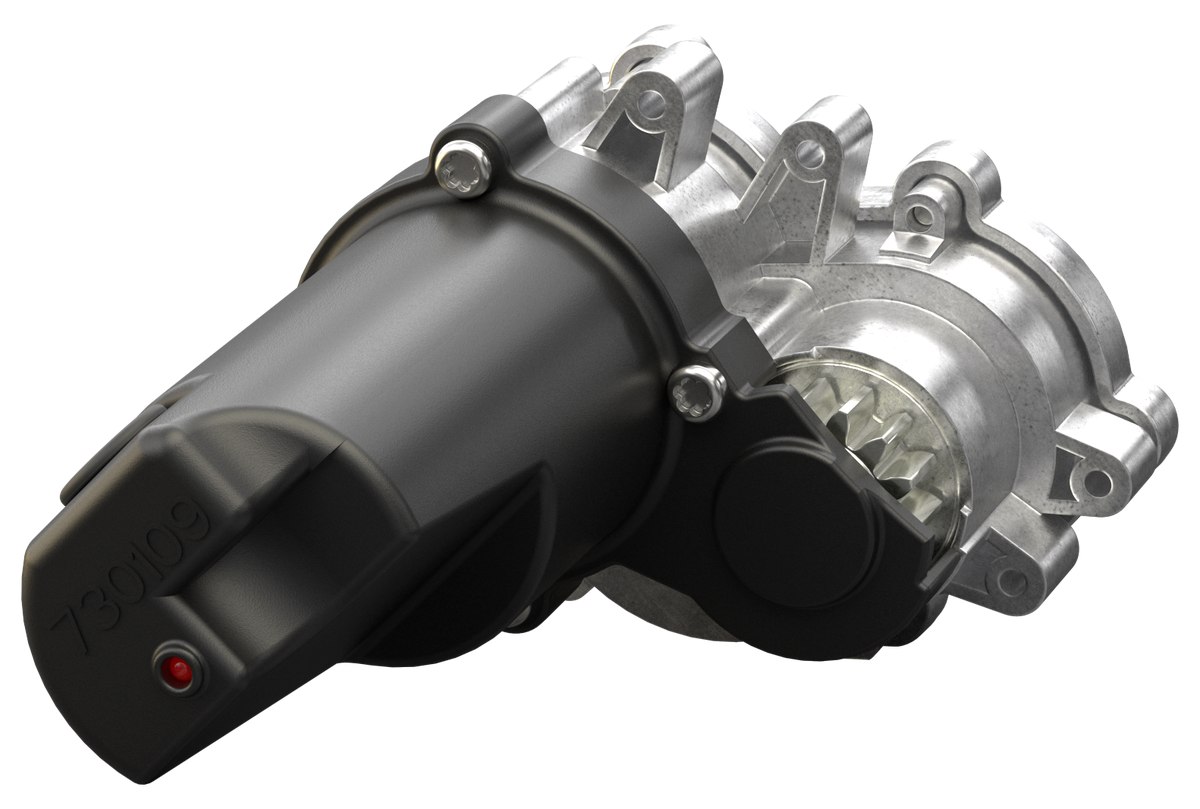
Electric seed-meter drive
Precision Planting vDrive
A row-level electric drive replacing a planter’s shared mechanical drive architecture. It controls seed-meter movement; agronomic population targets must still be established separately.
Meter, display, electrical supply and crop compatibility need checking.
View product details ↗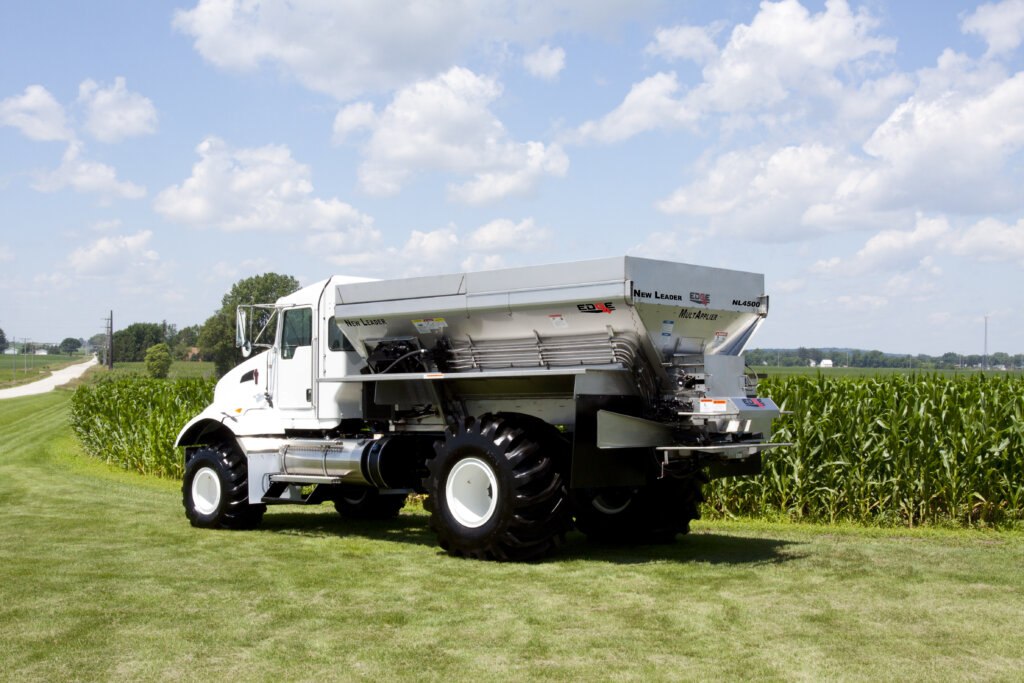
DirectCommand granular control configuration
Ag Leader Granular Application
An application architecture for dry products with supported rate and multi-product functions. Compare the actual metering package and field-record export with your intended material.
Calibrate material delivery and distribution; a rate command does not establish spread uniformity.
View product details ↗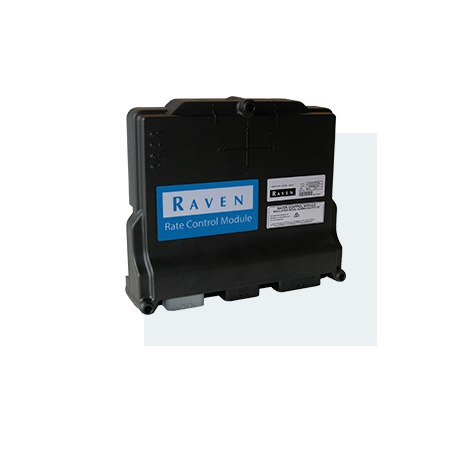
RCM; application-specific configuration
Raven Rate Control Module
A rate-control module configured for different agricultural application jobs. Its flexibility requires matching the hardware, terminal and application-specific control settings.
Channel functions and terminal support depend on setup; specify the implement rather than module alone.
View product details ↗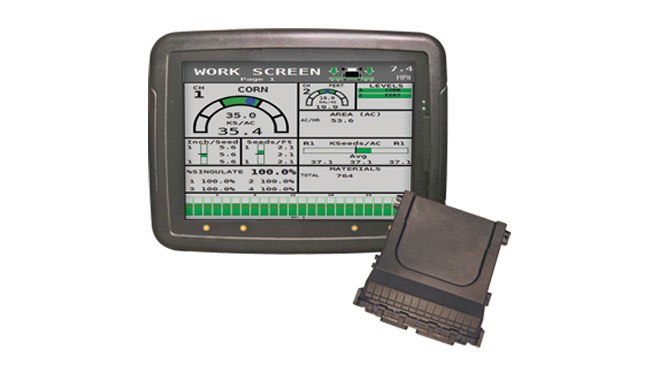
Current eight-channel ISOBUS module
DICKEY-john IntelliAg ISO6
A currently listed ISOBUS monitor/control module with configurable I/O. Select the planter, seeder or spreading configuration and required sensor package explicitly.
Confirm functions against the module version, terminal and implement; older ISO6 documents differ.
View product details ↗| Model | Measurement / role | Data connection | Coverage / installation |
|---|---|---|---|
| PTx Trimble Field-IQ | Rate, section and seed-delivery control | Compatible display and configured drives/sensors | Matched planter, spreader, sprayer or seeder package |
| Precision Planting vDrive | Row-level seed-meter actuation | 20|20 control and row electrical hardware | Supported seed meters/planter rows; matched installation |
| Ag Leader Granular Application | Dry product delivery and spinner/control feedback | InCommand display and configured control modules | Supported spreader or strip-till installation |
| Raven Rate Control Module | Liquid, granular or seeding application control | ISOBUS-capable control architecture | Supported implement with matching sensors and actuators |
| DICKEY-john IntelliAg ISO6 | Seed, liquid and granular monitoring/control | ISOBUS with supported terminal and sensor/control configuration | Supported planter, air seeder, spreader or drill |
ISOBUS needs a functionality check
ISOBUS supports communication between agricultural equipment, but an ISOBUS connection does not establish every task-controller feature. Check Universal Terminal support for operating the implement, Task Controller GEO for geographically referenced jobs and rate control, and Task Controller Section Control for compatible section switching. Use the AEF database to check the exact tractor, terminal and implement combination where listed.
Also identify the physical hardware. Meter motors, flow sensors, valves, harnesses and power supplies must suit the application. A seeding system needs crop and meter compatibility; a spreader needs suitable metering and distribution calibration. An electronic rate command does not fix an uneven spread pattern.
Validate rates before making a full-field pass
Check units when importing prescriptions. A map specifying kilograms of product per hectare differs from one specifying kilograms of nutrient per hectare. Confirm coordinate reference, field boundary, allowable rate limits, minimum-rate behaviour and what the controller does outside the prescription. Inspect the imported map on the display before entering the field.
Run a stationary calibration or catch test where the manufacturer specifies it, then verify delivery at operating speed. Test low, middle and high rates with the intended material. Check section response, headland transitions and behaviour when the position signal is lost. Preserve both the prescription and the resulting application record.
A rate calculation with explicit assumptions
A liquid target of 150 litres per hectare at 12 kilometres per hour over 24 metres needs 150 × 12 × 24 ÷ 600, or 72 litres per minute. If half the width is active, demand falls to 36 litres per minute under the same assumptions. This calculation concerns volume delivery; droplet size, pressure and nozzle limits still determine whether the spray pattern suits the treatment.
For fertiliser, product composition matters as well as machine flow. Applying 100 kilograms per hectare of a product containing 20% nitrogen supplies 20 kilograms of nitrogen per hectare. Confusing product rate with nutrient rate creates an agronomic error that accurate electronics will faithfully reproduce.
Control increasingly depends on interoperability
The Agricultural Industry Electronics Foundation was founded in October 2008 to support industry cooperation. Its ISOBUS functionality framework makes compatibility more specific than a generic connector label. The development from separate controllers toward integrated terminals expands what a farm can coordinate, while leaving calibration and the agronomic prescription as necessary parts of the workflow.
Application terminology
- Prescription
- A spatial or sensor-derived target for input delivery.
- PWM
- Pulse-width modulation, used to control compatible actuators by changing the duty cycle of electrical pulses.
- Closed loop
- Control that uses a measured response to adjust an output.
- Look-ahead
- A configured advance intended to compensate for control and material-delivery delays.
Can satellite imagery become a fertiliser prescription?
It can contribute evidence about crop variation, but the conversion needs an agronomic model and field checks. A vegetation index does not directly measure the amount of fertiliser needed. Validate the recommendation, units, machinery limits and export format before transferring the prescription to the controller.