Water chemistry determines how an irrigation supply interacts with fertilisers, emitters and roots. pH and electrical conductivity are useful operating measurements, while alkalinity, specific ions and microbiological quality require additional tests. A monitoring system should distinguish these quantities rather than treat a single number as a complete water-quality assessment.
pH, conductivity and oxygen
pH expresses hydrogen-ion activity on a logarithmic scale. A change of one pH unit corresponds to a tenfold change in that activity. It does not measure the amount of acid required to reach a target: alkalinity describes the water’s acid-neutralising capacity. Two water sources with the same initial pH can therefore require different acid additions.
Electrical conductivity, or EC, measures the ability of dissolved ions to carry current. Common irrigation units are mS/cm and dS/m; 1 mS/cm equals 1 dS/m. Conductivity rises with temperature, so comparisons require either measurements at the same temperature or a clearly stated compensation convention. An EC-derived total-dissolved-solids display applies a conversion factor; it is not a direct chemical analysis of dissolved mass.
Dissolved oxygen is commonly reported in mg/L or as percentage saturation. It is especially relevant to recirculating water and aquaculture, where temperature, aeration and biological demand affect oxygen availability. An instrument reporting percentage saturation needs appropriate temperature and atmospheric-pressure compensation. pH and EC probes do not supply that measurement.
Five instruments for different sampling roles
The comparison includes a continuous reservoir monitor, a handheld hydroponic meter, an environmental multiparameter handheld, an integration kit and a laboratory bench instrument. Their measurement roles overlap, but their deployment and supporting equipment differ. A bench instrument supplies controlled sample measurements; it is not a weatherproof field monitoring node.
Guardian Monitor Wi-Fi BGUSTD02; reservoir probes
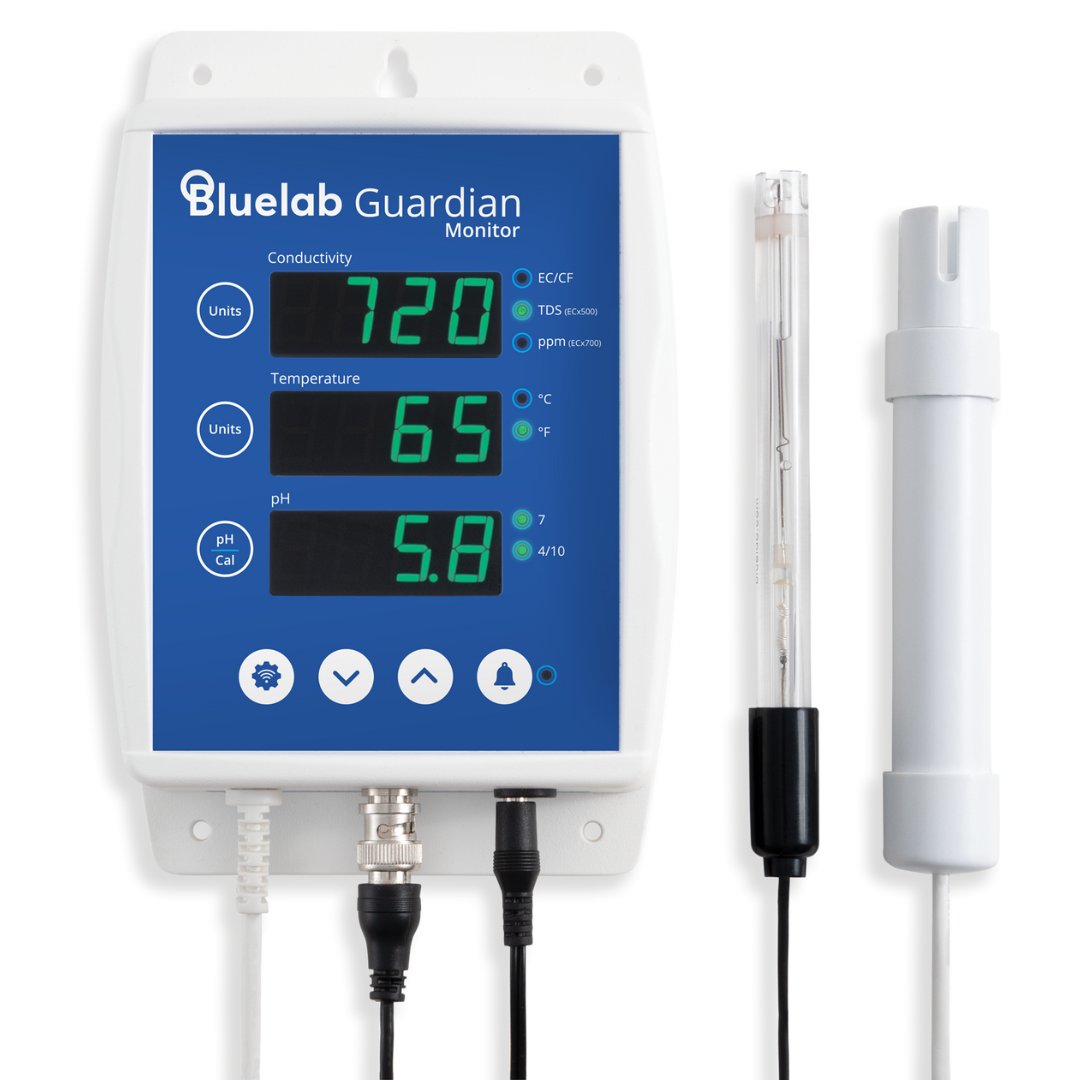
Bluelab Guardian Monitor Wi-Fi
A mains-powered monitor with separate solution probes, local displays and remote monitoring through the Edenic connection.
This monitor does not dose nutrients or measure water content inside a slab.
View product details ↗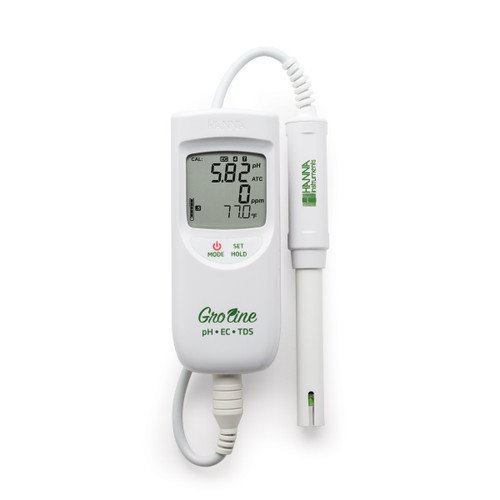
HI9814 portable meter with HI1285-7 probe
Hanna HI9814 GroLine
A portable multiparameter meter supplied with a replaceable three-in-one probe for nutrient-solution testing.
Sampling method affects interpretation; this is a portable meter rather than an installed control sensor.
View product details ↗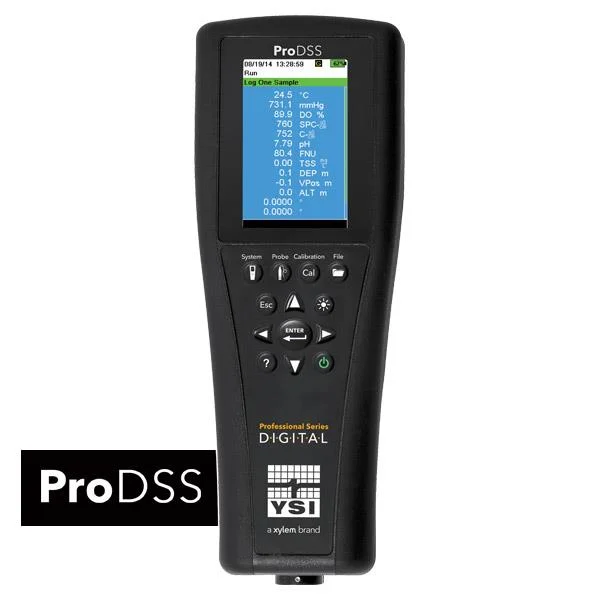
Handheld with selected digital sensors and cable
YSI ProDSS
A portable multiparameter platform for field sampling. The available readings are determined by the installed digital sensors, making it suitable for broader source-water investigations than pH/EC-only instruments.
Sensors, cable, depth option and accessories are configuration-dependent.
View product details ↗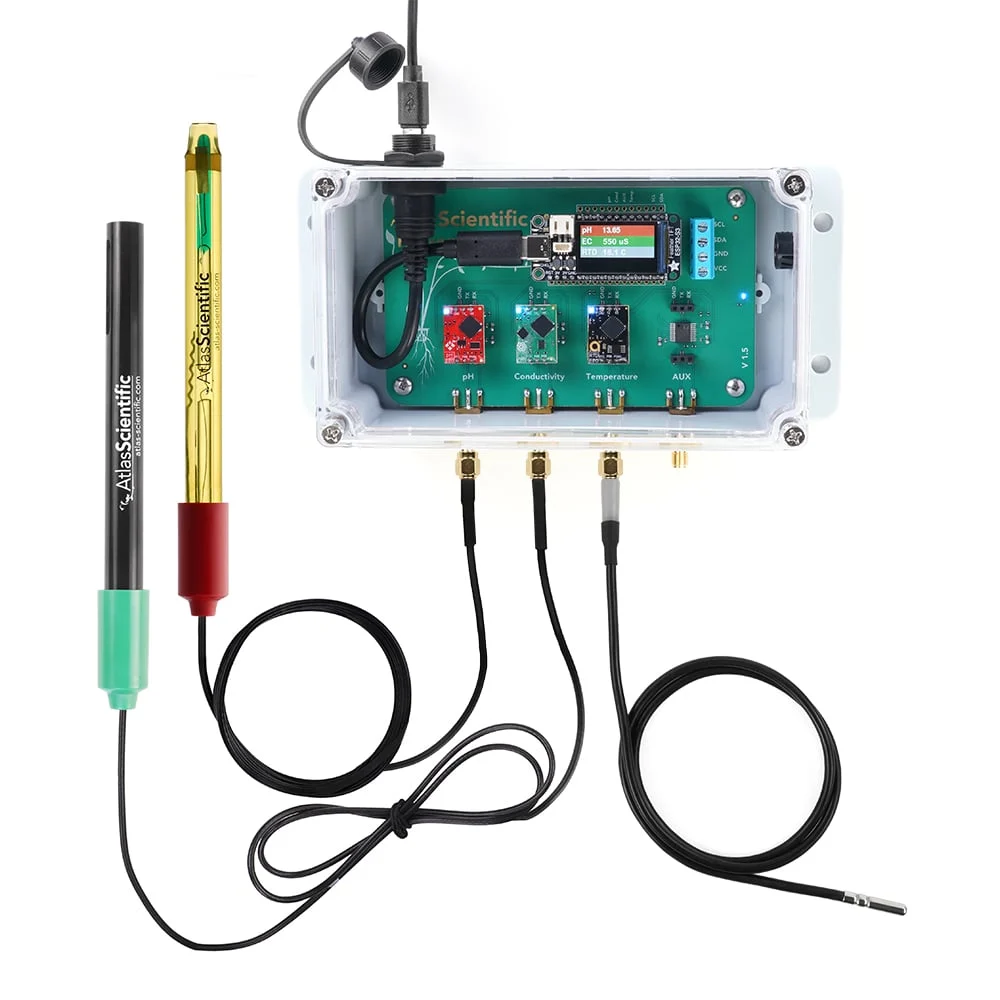
Assembled Wi-Fi-HK with selected pH and conductivity probes
Atlas Scientific Wi-Fi Hydroponics Kit
A preassembled measurement kit with electrically isolated measurement channels and a temperature probe. Its standard role is monitoring; dosing hardware is a separate part of the control design.
Cloud setup, probe selection, maintenance and enclosure exposure need planning.
View product details ↗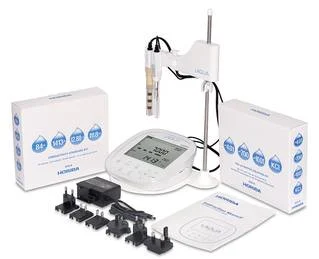
PC1100-S dual-channel benchtop kit
HORIBA LAQUA PC1100
A dual-channel bench meter combining pH and conductivity measurements with data storage. The PC1100-S kit includes specified electrodes, standards and an integrated stand.
A benchtop instrument needs suitable electrodes and a protected work area.
View product details ↗| Model | Measurement / role | Data connection | Coverage / installation |
|---|---|---|---|
| Bluelab Guardian Monitor Wi-Fi | Nutrient-solution pH, conductivity and temperature | Local display; Wi-Fi and Edenic for remote monitoring | Continuous measurement in a reservoir |
| Hanna HI9814 GroLine | Solution pH, EC/TDS and temperature | Handheld display; manual sample record | Spot checks of feed, drain or prepared media extracts |
| YSI ProDSS | pH/ORP, conductivity, dissolved oxygen and turbidity by sensor selection | Handheld logging; accessory and software options | Point sampling across source, reservoir and return water |
| Atlas Scientific Wi-Fi Hydroponics Kit | pH, conductivity and temperature | Wi-Fi upload to ThingSpeak; 5 V supply | Reservoir measurements with selected conductivity cell |
| HORIBA LAQUA PC1100 | pH/ORP, conductivity and derived solution quantities | RS232 and USB; AC adaptor | Collected laboratory or workroom samples |
How the sensors work
A glass pH electrode develops a potential related to hydrogen-ion activity, measured against a reference electrode. Its response depends on temperature and electrode condition. Calibration establishes the offset and slope using buffers, while the reference junction must remain suitable for the sample. A dry, fouled or aged electrode can respond slowly or drift without an obvious electrical fault.
Conductivity instruments apply an electrical excitation and measure the solution’s response across a cell. The cell constant links geometry to conductivity. Appropriate cell selection, temperature sensing and calibration standards are necessary across the intended concentration range. A reading within the instrument’s display range is not enough to establish that a particular probe has suitable accuracy there.
Optical dissolved-oxygen sensors infer oxygen from changes in a luminescent sensing layer. Electrochemical oxygen probes use a different measurement process and servicing regime. The chosen ProDSS sensor configuration determines which quantities are available; a handheld body alone does not include every optional measurement.
Sampling points and installation
Keep records for source water, mixed nutrient solution and return or drainage water distinct. Their differences can help identify concentration changes and dosing behaviour. A sample immediately beside an injection point may contain an incompletely mixed solution. Continuous instruments should observe a representative stream with adequate mixing and a serviceable installation.
For manual sampling, use clean containers, record the location and allow temperature and readings to stabilise. Consistent collection matters when comparing successive results. A portable instrument can verify a continuous monitor at the same point, but a comparison made between different water samples cannot isolate instrument error.
Flow cells can provide controlled exposure and convenient servicing where supported by the selected probe. Their flow and pressure limits still apply. Air bubbles, deposits and stagnant water can affect observations. Place cables and electronics within their specified environmental limits, even when the submerged probe itself is suitable for wet operation.
Calibration and dosing feedback
Use the manufacturer’s specified buffer and conductivity procedures, with standards that suit the measurement range. Keep a calibration record including the standard, temperature and electrode response. A check standard after calibration can reveal handling or configuration errors. Replace contaminated standards rather than return used solution to its bottle.
Acid and fertiliser dosing require an operating sequence that accounts for injection, mixing and measurement delay. A controller acting repeatedly before the previous dose reaches the probe can overshoot its target. Interlocks should prevent dosing without the intended water flow, and dose limits should remain effective if a probe loses credibility.
EC describes total ionic conductivity, not the concentration of each nutrient. Sodium and chloride can raise EC without supplying the desired nutrition. Ion-specific laboratory results are important when evaluating salinity, suitability for sensitive crops or accumulation in recirculating systems. Ion-selective electrodes require their own calibration, interference assessment and sampling procedures.
From laboratory chemistry to continuous records
The pH scale was introduced by Sørensen in 1909. Electronic electrode measurements later made routine pH testing widely accessible, and contemporary monitoring combines those measurements with digital logging and alarms. The underlying distinction remains: routine sensor observations support process operation, while a chemical analysis identifies the composition behind those observations.
- Alkalinity
- The capacity of water to neutralise acid, often expressed as mg/L as CaCO3.
- Cell constant
- A conductivity-cell geometry factor used to convert measured conductance into conductivity.
- Temperature compensation
- A calculation that accounts for temperature effects under a stated model.
- Ion-selective electrode
- An electrode responding preferentially to the activity of a particular ion, with possible interference from other species.
Questions about irrigation chemistry
Can EC determine the fertiliser recipe?
It can track overall conductivity but cannot identify individual nutrient proportions. Recipe formulation and source-water assessment require additional chemistry information.
Does low pH mean low alkalinity?
No. pH and acid-neutralising capacity are different properties. An alkalinity test informs acid requirement more directly than the initial pH alone.
Is a Wi-Fi monitor also a dosing controller?
Remote monitoring and alarms do not imply dosing outputs. Confirm the actual controller, dosing equipment and interlocks in the proposed package.